Most security programs still operate as if the job is mainly to find issues, patch issues, and repeat.
That loop is necessary, but it is not enough.
Cybersecurity is not just a vulnerability management problem. It is a strategic conflict between adaptive opponents. Attackers change tactics when defenders harden one path. Defenders reallocate controls when attackers shift to another. Costs, uncertainty, timing, and incentives all matter.
That is why game theory is useful in security.
Game theory gives us a formal way to think about cyber conflict as a system of strategic choices between attackers and defenders. Instead of treating security as a checklist of controls, it forces us to ask better questions:
- what is the attacker trying to maximize
- what is the defender actually optimizing for
- what does each side know
- when should we randomize, commit, inspect, or wait
This post is a practical guide to how game-theoretic thinking helps model cyber defense more rigorously, from Nash equilibrium and Stackelberg games to APT defense, digital forensic readiness, and even LLM-driven red teaming.
By the numbers
The economics alone justify a more strategic approach.
- IBM’s Cost of a Data Breach Report 2024 put the global average breach cost at USD 4.88 million, up from USD 4.45 million in 2023.
- In the same IBM study, 70% of the 604 surveyed organizations reported moderate or significant operational disruption from a breach.
- Organizations using AI in prevention workflows reduced average breach cost by USD 2.2 million and cut identification plus containment time by nearly 100 days.
- MITRE’s Enterprise ATT&CK tactics still anchor the problem around 14 tactics, while the October 2024 ATT&CK update listed 203 techniques in Enterprise ATT&CK.
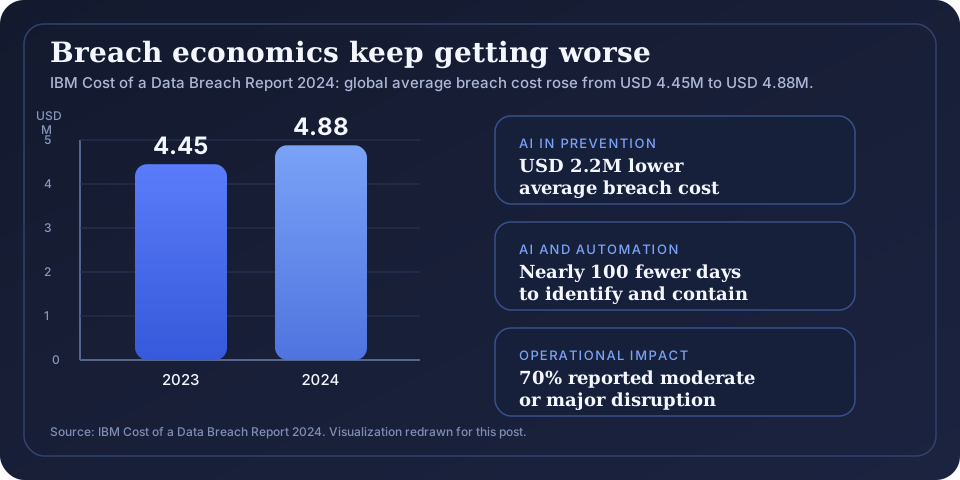
Figure: The cost side of the equation is already large enough that better resource allocation and faster containment materially change outcomes.
1) The core shift: security is a strategic system
At the most basic level, a cybersecurity game has two players:
- a defender trying to reduce loss, disruption, and operating cost
- an attacker trying to maximize impact, access, persistence, or profit
Each side has a set of actions. Each action has a cost. And each outcome has a utility.
That framing matters because most real security decisions are not binary.
Example:
- defender can invest in logging, segmentation, patching, deception, or isolation
- attacker can phish, exploit, move laterally, persist quietly, or burn infrastructure for speed
The outcome depends on both sides at once.
This is why simplistic “best practice” language often breaks down. A control is not universally good in the abstract. Its value depends on what the attacker is likely to do next, what the defender is trying to protect, and how much budget or operational friction the organization can tolerate.
Zero-sum and non-zero-sum thinking
Early security models often treated cyber conflict as a zero-sum game: if the attacker wins, the defender loses by the same amount.
That is sometimes useful for clean mathematical analysis, but most real security problems are not that neat.
In practice:
- attackers pay for tooling, infrastructure, time, and access
- defenders pay for controls, response overhead, latency, and usability tradeoffs
- partial success is common on both sides
That makes non-zero-sum models much more realistic.
A defender may successfully block lateral movement while still absorbing operational cost. An attacker may fail to reach the final target but still learn something valuable about the environment. Real security is full of these partial, asymmetric outcomes.
2) Information is incomplete, and that changes the whole game
Most security incidents happen under uncertainty.
Defenders rarely know:
- the attacker budget
- the attacker skill level
- whether the campaign is opportunistic or persistent
- which asset is the real objective
Attackers also operate under uncertainty. They usually do not know:
- how mature the monitoring stack is
- where the detection boundaries sit
- whether they are touching honeypots or real assets
- how fast defenders can contain and recover
This is why incomplete-information and Bayesian models matter.
In a Bayesian security game, each side reasons not just about actions, but about the opponent’s likely type.
For example, a defender may face multiple attacker types:
- a commodity actor optimizing for scale
- a criminal operator optimizing for ransomware payout
- a patient APT optimizing for stealth and long-term access
Those are not the same games. The right defense mix changes depending on which opponent you are most likely facing.
This is also where deception becomes strategically useful. If the defender can increase attacker uncertainty about what is real, watched, isolated, or costly to touch, the attacker has to spend more effort on reconnaissance and risk management.
Uncertainty is not just noise in the system. It is a controllable part of the defense.
3) Nash equilibrium explains why rigid defenses get exploited
A Nash equilibrium is a state where no player benefits from changing strategy unilaterally, given what the other player is doing.
That idea matters in cybersecurity because static, predictable defenses are often easy to optimize against.
If a defender always does the same thing:
- same patching order
- same inspection pattern
- same alert thresholds
- same control placement
then a capable attacker will simply adapt around that pattern.
Pure strategies are usually too brittle
In a pure-strategy world, the defender commits to one fixed move.
That is often fragile. If the attacker learns the pattern, the pattern becomes a weakness.
This is why mixed strategies are so important. In a mixed-strategy equilibrium, the defender randomizes actions according to a probability distribution.
That sounds abstract, but the intuition is simple:
- rotate patrols
- vary inspections
- randomize resets
- avoid making high-value coverage perfectly predictable
The point is not randomness for its own sake. The point is to make attacker optimization harder.
Access control is a good example
Take the RBAC versus ABAC debate.
RBAC gives strong, simpler boundaries, but it can be rigid. ABAC gives more flexibility, but it can become misconfigured and difficult to reason about at scale.
A game-theoretic framing is helpful because it turns the question from “which one is better?” into “what mix minimizes defender risk against the threat model we actually face?”
In many real systems, the answer is not a pure choice. It is a hybrid strategy.
That is one of the broader lessons game theory keeps forcing on security teams: the mathematically better answer is often a calibrated blend, not ideological commitment to one model.
4) Stackelberg games are often closer to real operations
Many security problems are sequential, not simultaneous.
The defender deploys a posture first. The attacker observes or infers that posture and then chooses where to act.
That is the logic of a Stackelberg game.
In a Stackelberg security game:
- the defender is the leader
- the attacker is the follower
- the defender commits to a strategy
- the attacker chooses a best response
This fits a lot of real-world security work:
- which assets get the strongest monitoring
- how often key systems are audited
- how sparse security coverage is distributed across many possible targets
- how defenders allocate limited resources across a large attack surface
The interesting part is that defenders do not need perfect coverage everywhere. They need a strategy that makes the attacker’s best response less attractive.
That is a different mindset from traditional compliance thinking.
Compliance asks: do we have controls?
Stackelberg reasoning asks: given limited resources, what defensive mix makes the attacker’s optimal move worse?
That framing is one reason these models have been useful in physical security, infrastructure protection, and patrol scheduling. The same logic maps well to cyber environments where full coverage is impossible. The security-games literature explicitly points to deployments such as ARMOR at LAX and IRIS for the US Federal Air Marshals as canonical examples of randomized leader-follower defense in practice.
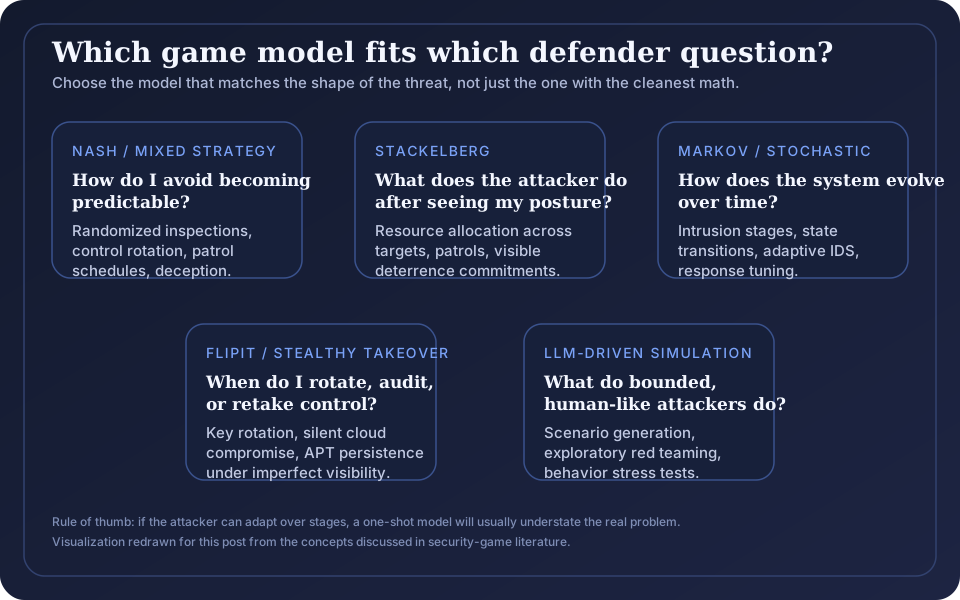
Figure: Different game models answer different defender questions. Using the wrong model often means defending the wrong shape of problem.
| Model | Best defender question | Typical security use |
|---|---|---|
| Nash / mixed strategy | How do I avoid becoming predictable? | Patrol randomization, deception scheduling, rotating inspections |
| Stackelberg | What does the attacker do after seeing my posture? | Resource allocation across targets, visible deterrence, critical asset coverage |
| Markov / stochastic | How does risk evolve over multiple stages? | Intrusion progression, IDS tuning, adaptive response |
| FlipIt | When should I rotate or retake control under stealth? | Key rotation, silent cloud compromise, APT persistence |
| LLM simulation | What do bounded, human-like attackers do? | Scenario generation, exploratory red teaming, behavior stress tests |
5) Dynamic attackers require dynamic models
Static games are useful, but real intrusions unfold over time.
Networks move between states:
- healthy
- exposed
- vulnerable
- partially compromised
- persistently compromised
- contained
That is where stochastic and Markov games become useful.
A Markov security model lets the defender reason about how the system changes from one state to another based on the joint actions of attacker and defender.
This is much closer to what happens in practice:
- an exploit attempt changes the risk state
- a containment action changes the reachable attacker options
- an IDS tuning change alters detection probabilities
- a credential reset can force the attacker to re-establish access
The value of these models is not just academic elegance. They let defenders think in terms of state transitions and long-term trajectories, rather than isolated alerts.
That shift is critical when the attacker is patient.
6) APT defense is not a single game
Advanced Persistent Threats are difficult precisely because they do not behave like one-shot attackers.
They move slowly. They gather context. They avoid detection. They trade speed for persistence.
Traditional single-stage models often fail here because the real contest is multi-step.
GADAPT and layered defense thinking
One useful idea from APT modeling is to treat infrastructure as a sequence of defensive layers around high-value assets.
At each layer:
- the attacker can move or wait
- the defender can inspect, reset, isolate, or monitor
That sounds simple, but it captures something important: the correct defense is not identical at every stage of intrusion.
Outer layers may emphasize uncertainty and detection. Inner layers may emphasize containment, privilege minimization, and rapid invalidation of attacker progress.
Game-theoretic APT frameworks are useful because they encode those stage-specific tradeoffs explicitly.
FlipIt and stealthy control contests
The FlipIt model is especially relevant for stealthy compromise.
In FlipIt-style scenarios, both sides are competing for control of a resource, but neither side has perfect visibility into when the other has taken over.
This maps well to:
- compromised cloud workloads
- stolen credentials
- cryptographic material
- silently subverted management planes
The defender’s problem becomes one of timing:
- when do you rotate
- when do you audit
- when do you reassert control
- how much is that action worth given uncertainty and cost
That is a very different question from simple prevention checklists.
7) Attack-defense trees help make complex systems tractable
For large cyber-physical systems, the strategy space can become enormous.
Power grids, avionics systems, industrial control environments, and safety-critical operational networks all have digital and physical consequences. Defending them requires understanding not just whether an attack is possible, but which paths are plausible and worth defending against first.
Attack-defense trees are useful here.
They let defenders model:
- attacker entry points
- dependency chains
- required sub-steps
- defender countermeasures
The big advantage is not just visualization. It is tractability.
If you can prune low-probability or low-value paths, you can reduce the game space enough to reason about resource allocation in a more disciplined way.
That matters because mature defense is rarely about protecting every node equally. It is about identifying where a marginal unit of defense changes attacker utility the most.
8) Digital forensic readiness is also a strategic decision
Digital Forensic Readiness is often treated as a secondary concern that only matters after something bad happens.
That is a mistake.
If you cannot collect, preserve, and interpret evidence efficiently, then every serious incident becomes more expensive, slower to contain, and harder to learn from.
For smaller organizations especially, the real question is not “should we improve forensic readiness?” It is “where do we invest first?”
Game theory helps because it formalizes the tradeoff between:
- attacker tactics
- defender evidence collection
- control cost
- investigative value
This is where mappings like MITRE ATT&CK and MITRE D3FEND become useful. They provide a structured way to think about attacker moves and defensive control families.
One of the most important lessons from this work is that detection and evidence quality are not soft nice-to-haves. Against high-impact attacks, they are often among the highest-leverage defensive investments.
In other words, if the threat is serious enough, “Detect” is not just an operational capability. It is an equilibrium strategy.
9) LLMs matter here, but not as perfect rational agents
The arrival of LLMs creates a new and interesting wrinkle in cyber game theory.
Traditional game-theoretic agents optimize explicit payoff functions. LLMs do not behave that way. They are language-conditioned systems with bounded rationality, prompt sensitivity, and behavioral drift.
That makes them dangerous to overtrust as autonomous optimizers.
But it also makes them useful.
Where LLMs fall short
LLMs are not stable minimax engines.
Their behavior can shift based on:
- wording
- persona framing
- language choice
- context window composition
- prior conversational state
That means they can deviate meaningfully from clean equilibrium predictions. In high-stakes real-time defense, that inconsistency is a serious limitation.
Where LLMs are actually valuable
For simulation and exploratory adversarial modeling, those imperfections are a feature.
Human attackers are not perfect optimizers either.
They are:
- bounded
- inconsistent
- biased
- sometimes greedy
- sometimes overconfident
That means LLMs can be useful as synthetic red-team actors in “what-if” scenarios, especially when the goal is not provably optimal action, but richer exploration of plausible attacker behavior. Work such as FAIRGAME and a later Frontiers evaluation is useful here because it shows the limitation clearly: the models are strategic enough to simulate, but not stable enough to trust as autonomous optimizers. The Frontiers study evaluated four models across five languages and found substantial cross-language inconsistency, with GPT-4o and Llama 3 behaving more consistently than Claude 3.5 Sonnet and Mistral Large.
The right operating model is not “let the model run defense.”
It is:
- use deterministic policy for real authorization
- use formal models for strategic reasoning
- use LLMs to generate scenarios, attacker narratives, and imperfect-but-useful adversarial behavior
10) What this means for real security teams
Game theory does not magically solve cybersecurity.
It does something more useful: it forces clarity.
If you want to apply game-theoretic thinking in a real program, start here:
- Define the assets that actually matter.
- Write down defender utility explicitly: what are you optimizing for?
- Identify attacker goals and likely attacker types.
- Separate static choices from sequential choices.
- Use randomness where predictability helps the attacker.
- Model state transitions for persistent threats, not just single alerts.
- Treat logging, telemetry, and evidence preservation as strategic investments.
- Use LLMs as bounded adversarial simulators, not autonomous decision authorities.
Even if you never build a full formal model, this mindset alone improves security decisions.
It pushes teams away from vague slogans and toward explicit tradeoffs.
Closing
The deeper value of game theory in cybersecurity is not that it makes defense perfect.
It is that it treats security for what it actually is: a contest between adaptive opponents under cost, uncertainty, and incomplete information.
That is a much better model of the real world than the old “just add more controls” mindset.
The teams that get ahead will be the ones that stop treating cybersecurity as a static compliance exercise and start treating it as strategic resource allocation against an intelligent adversary.
That is the real shift from reactive defense to resilient defense.