ARCHITECTURE LOG
x86 from the Metal Up
Bits, bytes, registers, flags, and the few instructions that explain 80% of what you will see in any disassembler.
Every shellcode analysis starts with the same five-minute orientation. Read the registers, read the flags, find the loop, follow the jump. Once you can do that, the rest of x86 is just vocabulary. This is the orientation.
The only prerequisite is to know the basics of a C-family language. Everything else — what a register is, what a flag is, why the stack grows backwards — is below. The order matters: each section assumes the one above it.
The data types
x86 deals in four sizes: bits, bytes, words, and double words.
A bit is a 0 or a 1. Eight bits make a byte, which holds 0 to 255. Two bytes make a word, which holds 0 to 65,535. Two words (four bytes, 32 bits) make a dword, which holds 0 to 4,294,967,295. Every register, every memory address, every instruction operand in 32-bit x86 is one of these four sizes. Once you internalize the size table, half the disassembler stops looking like noise.
Registers
A register is a tiny storage cell on the CPU itself. Faster than main memory by an order of magnitude, limited in number, addressed by name rather than by address. The 32-bit x86 architecture gives you eight general-purpose registers, and Intel’s original engineers had specific uses in mind for each — the names are the hint.
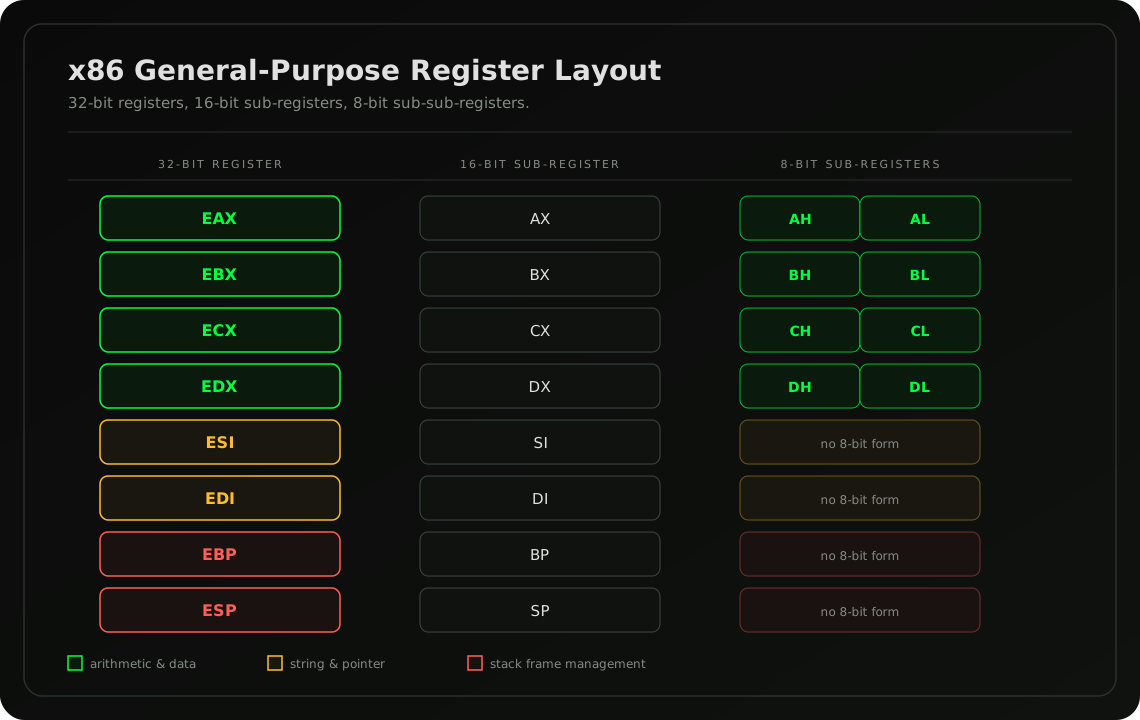
Two of them are special. EBP and ESP are the base pointer and stack pointer — the two registers that own the function call machinery. Every modern compiler reserves them. You can technically use them as general-purpose registers, but the moment a function forgets to save and restore the original value, the entire stack frame collapses and the program crashes in ways that are nearly impossible to debug. If you ever see someone using EBP or ESP outside compiler-generated code, assume they are writing the kind of assembly that requires a debugger open at all times.
The other six are fair game, though the first four still have the strongest conventions. EAX is the accumulator — most arithmetic operations place their result there. ECX is the counter — LOOP decrements it, REP chains through it. EDX is the data register — the upper half of multiplication and division results. EBX is the base register — the only general-purpose register that survived the 16-bit era unchanged. ESI and EDI are the source and destination index registers — they walk through memory during string and buffer operations.
Every 32-bit register is a full 32 bits wide, but the lower 16 bits of each have their own two-letter name (AX, BX, CX, DX, SI, DI, BP, SP) for backward compatibility with 16-bit code. The first four of those 16-bit registers go one step further: the lower 8 bits are AL, BL, CL, DL and the upper 8 bits are AH, BH, CH, DH. When a disassembler shows you mov al, 0x41 instead of mov eax, 0x41, the author is being precise about which byte they care about. Watch for it.
Flags
Beside the eight general-purpose registers, the CPU maintains a single register of one-bit flags. Each flag is a tiny status signal that the most recent operation set or cleared. Most instructions touch at least one. The four that matter for almost every binary you will ever read:
- Z — zero flag, set when the result of the last operation is zero
- S — sign flag, set when the result is interpreted as negative
- O — overflow flag, set when the result switches the most significant bit
- C — carry flag, set when the most significant bit is carried out
The flags exist so that conditional jumps can ask questions. JE (jump if equal) checks Z. JG (jump if greater) checks S, O, and Z together. JLE (jump if less or equal) checks the same three. There are roughly 30 conditional jumps, none of which you have to memorize. The Intel manuals list which flags each one checks. Read the table once, look it up the next 200 times you need it.
The other register that matters is EIP, the extended instruction pointer. It points to the next instruction the CPU will execute, and every JMP, CALL, and RET instruction modifies it. EIP is the needle on a record player — the rest of the registers are the song.
Segments and the memory model
Every running program is divided into four memory regions. The .text segment holds the program code. The .data segment holds global variables. The .stack segment holds local variables, function arguments, and return addresses. The .heap segment is where dynamic allocations live, shared across all threads in the process.
The stack is the part you need to understand. It is a Last In, First Out structure that grows backwards — from the highest memory address toward the lowest. The two registers that own it are ESP, which always points to the top of the stack, and EBP, which marks the start of the current function’s frame. When a function is called, the caller’s return address is pushed onto the stack, the callee’s local variables are pushed on top of that, and EBP is set to point at the new frame. When the function returns, the stack unwinds and ESP is restored. The entire mechanism is implemented by two instructions: CALL (push return address, jump) and RET (pop return address, jump). The prologue and epilogue of every compiled function exist to keep this dance orderly.
The heap is the opposite — a linked list of free and allocated blocks, managed by malloc and free (or their C++ and OS equivalents). Exploit writers care about the heap because heap overflows corrupt the linked-list metadata and let attackers redirect execution. Defenders care because heap corruption is the most common class of memory-safety bug in modern software.
Instructions
x86 instructions vary in length from one byte to fourteen bytes. Every instruction begins with an opcode — the operation code that tells the CPU what to do — and may be followed by zero, one, two, or three operands. Most instructions take two operands, like add eax, ebx. A few take one, like not eax. A few take three, like imul eax, edx, 64. The source operand can be a register, a memory address, or an immediate value. The destination can be a register or a memory address. You cannot have two memory addresses in the same instruction — the CPU has no instruction format for that — so any two-operand instruction with a memory reference must use a register as the other operand.
When a disassembler prints dword ptr [eax], the brackets mean “the double word at the memory address currently in eax.” The dword says it is reading 4 bytes. The ptr says it is a pointer dereference. Together, the expression means “fetch the 32-bit value from memory at the address eax is holding.” The opposite — the address of a memory location, rather than its contents — is what LEA (load effective address) computes. lea eax, [ecx+edx] puts the address ecx+edx into eax without reading from that address. The arithmetic happens on the address itself, which is why compilers use it as a fast way to add two registers.
Bytes in memory are stored in little-endian order. The least significant byte of a value is stored first. If you write mov eax, 0x12345678 and then look at the bytes in memory, you will see 78 56 34 12, not 12 34 56 78. This is the single most common source of “the bytes don’t match” confusion when reading shellcode. It is not a bug. It is the architecture. Get used to reading hex dumps backward.
The instructions that matter
The full x86 manual runs to thousands of pages. The instructions you will see in 90% of disassembly, in order of frequency:
Data moving. MOV is the most common instruction in any compiled program — it copies a value from source to destination. MOVSX and MOVZX extend a smaller value to a larger one, filling the new bits with the sign bit or with zeros respectively.
mov eax, 0x41          ; load the immediate value 0x41 into eax
mov ebx, [esp]         ; load the dword at the top of the stack into ebx
movzx eax, byte [esi]  ; load a single byte from [esi], zero-extend into eax
lea eax, [ecx+edx*4+8] ; compute the address ecx+edx*4+8, store in eax
Arithmetic. ADD and SUB are the obvious ones. MUL and IMUL multiply, with the result in EDX:EAX for the unsigned-without-operand form. DIV and IDIV divide, with the quotient in EAX and the remainder in EDX.
mov eax, 65            ; dividend
mov ecx, 4             ; divisor
div ecx                ; eax = 16, edx = 1 (remainder)
Bitwise. AND, OR, XOR, NOT. Two pieces of data, compared bit by bit. XOR is the interesting one — any value XORed with itself becomes 0, which is why compilers zero a register with xor eax, eax instead of mov eax, 0. The XOR path is one byte shorter and one cycle faster on most CPUs.
xor eax, eax           ; eax = 0, faster than "mov eax, 0"
and eax, 0xFF          ; keep only the low byte of eax
or  eax, 0x100         ; set bit 8 of eax
not eax                ; flip every bit of eax
Branching. JMP is unconditional. The conditional jumps check flags set by a previous instruction, almost always CMP (compare) or TEST (bitwise AND that discards the result, used for checking single bits).
cmp eax, ebx
je  .equal             ; jump if eax == ebx
jg  .greater           ; jump if eax > ebx (signed)
jbe .not_greater       ; jump if eax <= ebx (unsigned)
Looping. The LOOP instruction decrements ECX and jumps to the target if ECX is not zero. It is a relic of the 16-bit era, rarely generated by modern compilers, but it shows up in hand-written assembly and shellcode. The REP prefix is more interesting — it repeats the following string operation (MOVS, STOS, CMPS, SCAS) ECX times.
mov ecx, 5
_proc:
  dec ecx
  loop _proc           ; loops 5 times
The mental model
Once the above is internalized, almost every disassembled function follows the same shape. A prologue saves the old EBP and sets up a new frame. The body loads arguments, does work, branches based on conditions, and moves results into EAX to return. An epilogue restores the old EBP and returns.
The exceptions are interesting. Loops and function calls use ECX and the stack, not EAX. String operations use ESI and EDI as source and destination. Some compilers will use any register for any purpose, especially with optimization enabled, which is why disassembly without symbols is genuinely hard. But the model holds often enough that it is the right starting point.
The deeper instruction set — LOOP, REP, MOVZX, the floating-point FPU stack, the MMX/SSE/AVX vector instructions, the AES-NI and SHA-NI hardware-accelerated crypto — is for later. None of it changes the mental model. The mental model is: registers are 32-bit scratchpads, flags are tiny status signals, the stack is a LIFO that grows downward, memory is byte-addressed little-endian, and the instruction pointer walks through the program one instruction at a time. Everything else is vocabulary on top of that.
DISCUSSION CHANNEL
Comments
Sign in with GitHub to join the discussion.