ARCHITECTURE LOG
Understanding the Concept of Brahman and Atman
On the non-dual identity of self and absolute reality in Advaita Vedanta.
Most of us live inside a useful fiction: that we are a bounded self looking out at an external world. Advaita Vedanta calls that fiction into question. Its core claim is not mystical in the escapist sense; it is a rigorous argument that the self we take ourselves to be and the ultimate reality we seek are not two different things.
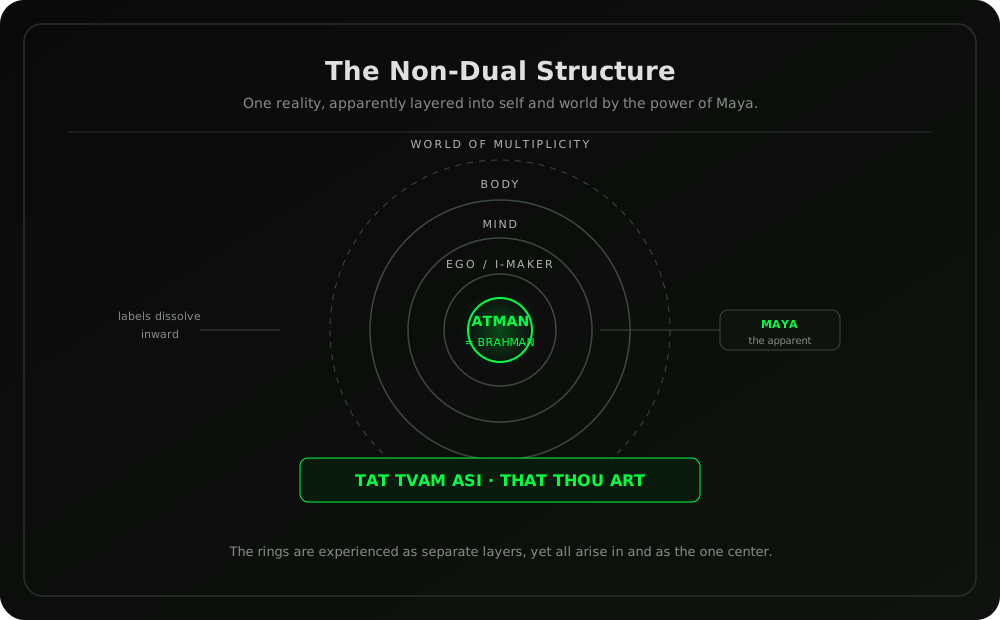
The tradition centers on three concepts: Brahman, the absolute; Ātman, the innermost self; and Māyā, the power by which the one appears as many.
Brahman: not a god, but the ground
Brahman is not a deity among others. It is the single, undivided ground of existence, the reality that remains when every name, form, and limit is subtracted. The Upanishads describe it as Sat-Chit-Ananda: existence, consciousness, bliss. Not three attributes, but three ways of pointing at the same irreducible fact.
The Kena Upanishad puts it negatively: “That which the eye does not perceive, but because of which the eye perceives, that know as Brahman.” This is not obscurantism. It is a precision move. Brahman is not an object within experience; it is the condition that makes any experience possible.
Ātman: the self beneath the labels
Ātman is what is left when you strip away the body, the mind, the roles, the memories, and even the sense of “I am this person.” It is not a smaller self hidden inside the ego. It is the bare fact of being aware, prior to every identification.
The tradition is clear that Ātman is not something to be obtained. It is what you already are, obscured by habit and misidentification. The work is not acquisition; it is removal.
Tat Tvam Asi: the identity
The Chandogya Upanishad states the conclusion directly: Tat Tvam Asi — That thou art. The “That” is Brahman; the “Thou” is Ātman. The boundary between them is not metaphysical but epistemic. We do not see the identity because we are looking from the wrong place.
This is the non-dual move. It does not merge two things into one. It says the apparent twoness was never real in the first place. What looked like self confronting world is more like wave insisting it is separate from water.
Māyā: the apparent differentiation
If Brahman is one and we are Brahman, why does separation feel so convincing? Advaita answers with Māyā, the power that makes the infinite appear finite and the one appear as many. Māyā is not a lie in the ordinary sense. The world is empirically real; it operates by causal laws and is perfectly valid for practical life. But it is not ultimately real. It depends on something else for its existence.
The classic metaphor is the rope mistaken for a snake in dim light. The snake is not entirely nonexistent as an experience; it is simply not what is really there. In the same way, multiplicity is a valid experience but not the final truth. Remove the misapprehension and only the rope remains.
The path of inquiry
Advaita is not a creed. It is a method of investigation called Jnana Yoga, the path of knowledge. The practice is sustained inquiry into the nature of the self, often through three disciplined questions:
- What is real? That which does not change when everything else changes.
- Who am I? Not the body, not the mind, not the accumulated biography, but the awareness in which all of these appear.
- What is the relation between the individual and the absolute? Not relation, but identity.
This inquiry demands a stable mind, ethical grounding, and a genuine hunger for clarity rather than comfort. It is not an intellectual game. The goal is not to hold the right opinion but to see through the wrong one.
It is not nihilism
A common misreading is that Advaita denies the world. It does not. It denies the ultimate reality of the world while affirming its empirical reality. The world is where we live, work, suffer, and love. But it is not the whole story. Recognizing that is what frees the seeker from taking the drama as final.
The Brihadaranyaka Upanishad captures the result: “When to the man of realization all beings become the very Self, what delusion, what sorrow can there be for that seer of oneness?” The freedom is not escape. It is the collapse of the felt separation that made escape seem necessary.
Why it matters
Advaita Vedanta is easy to dismiss as ancient metaphysics. That would be a mistake. Its central question — what is the true nature of the self? — is the same question that drives cognitive science, phenomenology, and the philosophy of mind today. The tradition offers a clean diagnostic: most of our suffering is downstream of misidentification. We treat temporary attributes as permanent identities and relative conditions as absolute limits.
The practical takeaway is not to stop engaging with the world. It is to engage without the compulsive need to defend a fictional self at the center of it. That is the move from bondage to freedom, from the apparent self to the real Self, from multiplicity to the non-dual Brahman.
DISCUSSION CHANNEL
Comments
Sign in with GitHub to join the discussion.