ARCHITECTURE LOG
Traditional manual code review is no longer sustainable
The volume of AI-generated code has broken the old review model. Here is what replaces it.
Code review made sense when humans wrote humans-sized diffs. A reviewer could read the change, understand the intent, and catch most errors. That model is breaking. AI coding assistants let engineers produce more code, faster, in larger chunks, with patterns the reviewer may never have seen before. The result is a widening gap between what gets written and what gets properly understood.
This is not a complaint about laziness. It is a structural mismatch. The old review process was designed for a slower, more constrained pipeline. It cannot scale to a world where code generation is cheap and verification is expensive.
The productivity paradox
AI coding tools clearly increase output. Teams using them report completing more tasks and merging more pull requests. But the review side has not kept up. Review times grow, diffs get larger, and reviewers spend more time trying to reconstruct context they did not participate in building.
The problem is cognitive, not mechanical. AI compresses the act of writing code. It does not compress the act of understanding it. When a human receives a 500-line generated diff in an unfamiliar style, the review becomes an archaeological exercise. The reviewer must infer intent, trace assumptions, and spot subtle flaws in logic they did not shape.
This is the AI productivity paradox: more code generated, less code deeply understood. The bottleneck moves from writing to verification.
Why manual review fails at scale
Humans are good at judgment and bad at exhaustive pattern matching. A fatigued reviewer is unlikely to catch a subtle security flaw buried in a generated function, especially when the surrounding code looks plausible. Static analysis of AI-generated code consistently finds issues that manual review misses: code smells that degrade maintainability, functional bugs in edge cases, and occasional critical security vulnerabilities.
The issue is not reviewer competence. It is that the task has outgrown the medium. Asking a human to reliably verify a large generated diff is like asking a proofreader to catch every typo in a book handed to them one hour before print. Some errors will get through. The ones that do become expensive.
The shift: review intent, not code
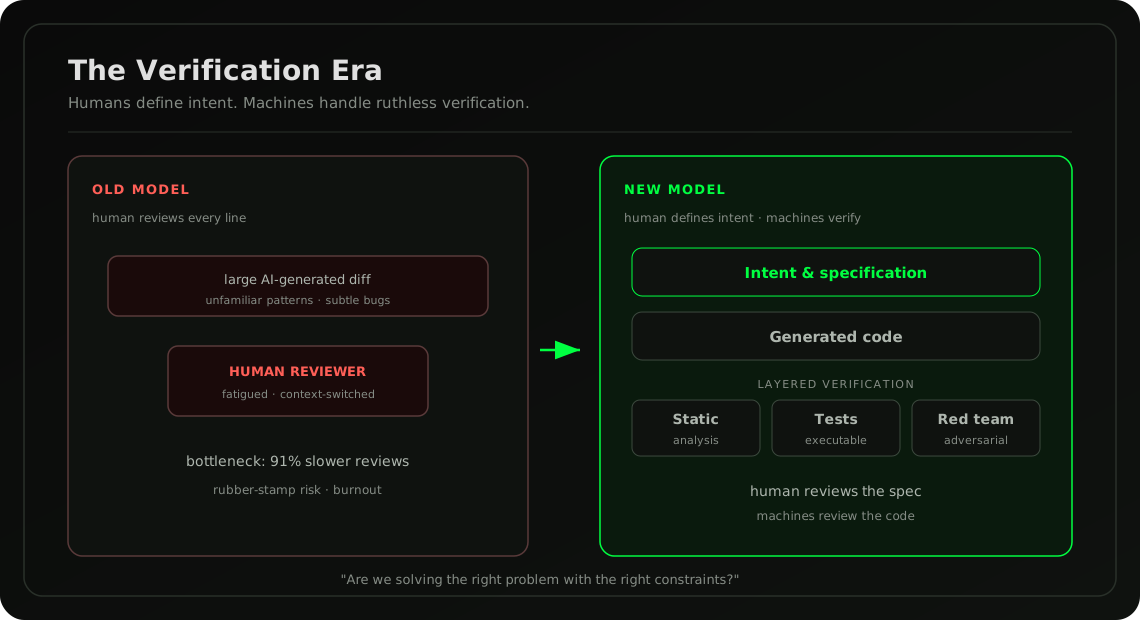
If we cannot read every line, we must move the human checkpoint upstream. The most valuable review happens before generation: defining what the change should do, what constraints it must respect, and what would constitute failure.
In this model, the specification becomes the source of truth. Code is an artifact of the spec. The human reviews the spec, the constraints, and the acceptance criteria. The machine verifies that the artifact matches them.
This changes the question from “Did you write this loop correctly?” to “Are we solving the right problem with the right boundaries?” The first question scales poorly. The second question is where human judgment is actually irreplaceable.
The verification stack
Moving away from manual line-by-line review does not mean trusting AI output. It means building systemic verification:
- Deterministic guardrails. Static analysis, linters, and security scanners catch known anti-patterns before a PR is submitted. The AI cannot negotiate with a failing CI pipeline.
- Test-driven validation. Behavior-driven tests encode intent in executable form. If the spec is correct and the tests pass, confidence increases.
- Adversarial verification. Separate agents can challenge implementation: one writes code, another tries to break it. This architectural separation targets edge cases and failure modes iteratively.
- Runtime validation. Observability, canary deployments, and fast rollback matter more when code is generated at volume. The final review happens in production, instrumented and reversible.
Some advanced teams are already experimenting with software factories where code is not human-reviewed at all. Instead, success is measured empirically against simulations and behavioral tests. Whether that approach spreads depends on the domain, but the direction is clear: verification is becoming automated, continuous, and empirical.
What humans do instead
The human role does not disappear. It elevates. Engineers spend more time on:
- Defining intent and constraints.
- Designing the verification architecture.
- Reviewing high-risk or novel changes.
- Maintaining the standards that automated tools enforce.
The goal is not to remove humans from quality. It is to stop wasting human attention on checks that machines can perform more consistently.
The bottom line
Manual code review is not evil. It is simply no longer sufficient for the volume and shape of code produced with AI assistance. The future belongs to organizations that shift from syntactic inspection to intent governance, supported by layered automated verification.
Ship fast. Verify ruthlessly. Revert faster. That is the only sustainable posture in the AI era.
DISCUSSION CHANNEL
Comments
Sign in with GitHub to join the discussion.