ARCHITECTURE LOG
The Socratic Dialogue
How a small group, a universal question, and a shared insistence on consensus can produce something no single mind could reach alone.
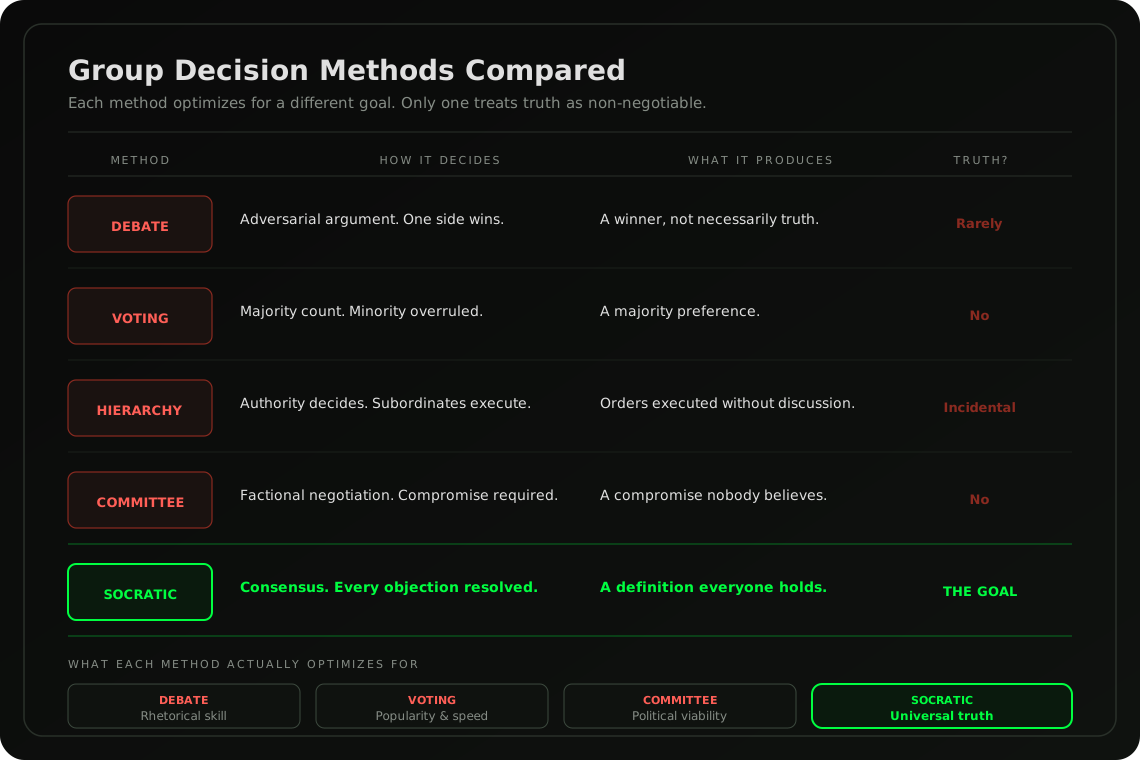
Most group decision-making is broken by design. Debates crown a winner, not an answer. Ballot boxes measure popularity, not correctness. Committees produce compromises nobody believes in. Hierarchies carry out orders nobody was allowed to question.
The Socratic dialogue is none of these things. It is a formal method by which a small group — typically five to fifteen people — finds a precise answer to a universal question. Not by argument. Not by voting. By consensus built from concrete experience.
I first encountered the method through a philosopher friend who facilitated sessions on questions like What is integrity? and Can conflict be fruitful? The surprise was not the answers the group arrived at. It was the process: patient, structured, and utterly unlike any meeting I had ever sat through. The method anticipates dissent and transforms it into consensus without suppressing it.
What it is, and what it is not
Socratic dialogue is often confused with the Socratic method — the technique Plato depicts Socrates using to expose contradictions in someone’s definitions by asking a chain of questions until they tie themselves in knots. That method is about discovering what something is not. The Socratic dialogue works in the opposite direction. It helps a group discover what something is.
There are no winners. There are no losers. Either the group reaches a definition that satisfies everyone, or it does not. Every objection, doubt, observation, and insight offered by any participant is weighed by the group as a whole until everyone is satisfied. The group moves forward only by consensus, which means the process is immune to the pathologies that ruin other group modalities. Debates reward rhetorical skill, not truth. Elections measure majority opinion, not correctness. Committees are notorious for divisiveness, acrimony, and unwholesome compromises — the third-man scenario where two factions stalemate and a middle position wins that neither side actually believes. Socratic dialogue refuses all of these shortcuts. It forces the group to sit with disagreement until it resolves, not until the clock runs out.
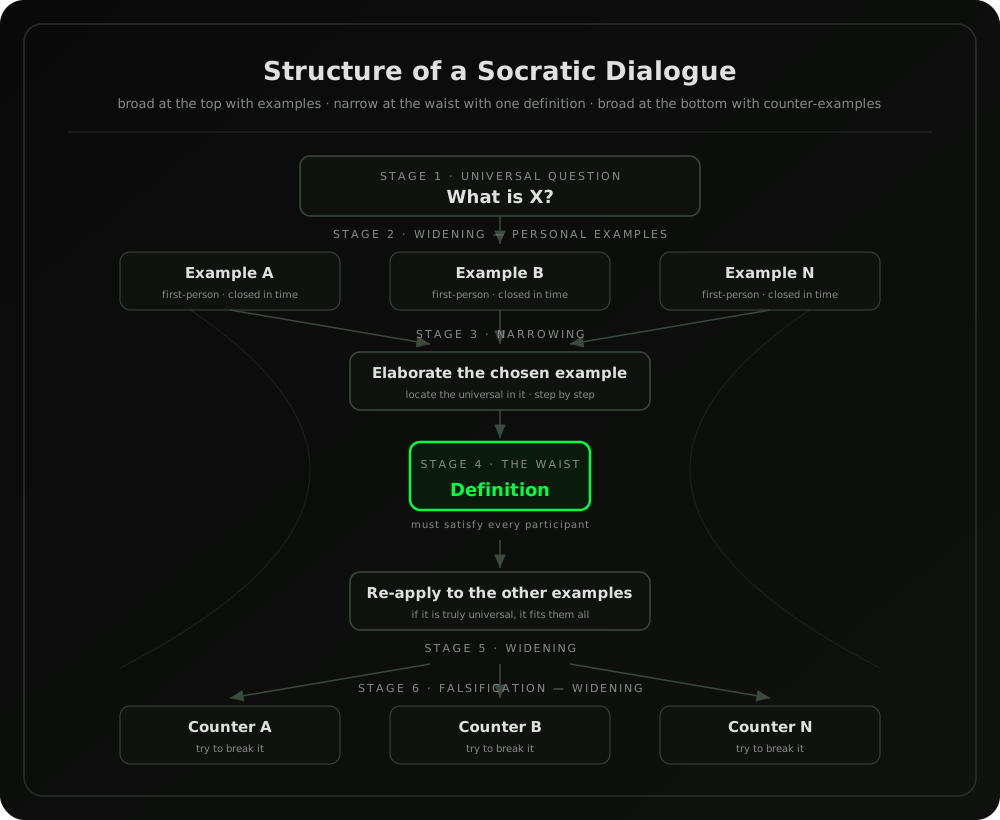
The hourglass
The dialogue follows a symmetric structure, widest at both ends and narrowest in the middle.
Top — the universal question. The group begins with a question of the form What is X? — What is integrity? What is happiness? What is justice? These are universals. The group’s task is to define one.
Widening — personal examples. Each participant offers a concrete example from their own life that they believe embodies the universal. The examples must be first-person, closed in time (their ramifications have settled), not overly emotional, and as simple as possible. Even the simplest example can lead to surprising complexity under group analysis. The group questions each example freely to understand it better, then chooses one to carry through the rest of the dialogue.
Narrowing — elaboration and location. The chosen example is elaborated in full detail by the person who offered it. Each step of the account is transcribed, numbered, and displayed so the group has a written history to consult. The group must then locate the universal in that example. At what step does integrity appear? Between which steps? This is the narrowing motion — from many possible examples down to a single one examined at the resolution of individual moments.
The waist — definition. The group articulates a definition that adequately describes what they located in the example. The definition must satisfy every participant. This is the narrowest point in the structure and roughly the midpoint in time. A universal has been particularized.
Widening — re-application. The working definition is now applied back to each of the other examples that were not elaborated. If the definition is truly universal, it fits all of them. If it does not, the group modifies it until it does.
Bottom — falsification. Finally, the group offers counter-examples to try to undermine or break the definition. Modifications are made if necessary. If the definition survives falsification and still satisfies every participant, the group has succeeded.
The three levels of discourse
A Socratic dialogue operates on three levels simultaneously, and the ability to distinguish between them is what prevents the process from collapsing.
First order: the dialogue itself. This is the content — the examples, the questions, the definitions, the objections. It is what the group talks about when it is doing the work.
Second order: strategy. Should the group return to an earlier example? Should it re-examine a step it glossed over? Is the definition drifting too far from the example? These are meta-questions about the direction of the dialogue, not about its content. Any participant can raise them at any time.
Third order: rules. What if a participant does not understand the procedure? What if someone asks a hypothetical question, which is not permitted? What if the facilitator needs to clarify a procedural point? These questions about the rules governing the dialogue form the third order. Any participant may request a meta-dialogue at any time, and the facilitator is responsible for answering it.
The facilitator is like a conductor. He has no voice in the score itself. He does not contribute examples, offer definitions, or argue points of substance. He transcribes the proceedings, guides the group through the structure, answers procedural questions, and may — if asked — offer suggestions about strategy. But the content belongs entirely to the group.
Why the method works
The method works because it refuses to separate the search for truth from the people doing the searching. It does not treat dissent as an obstacle to overcome. It treats dissent as information the definition has not yet absorbed. When a participant objects to a proposed definition, the group does not vote on whose objection carries more weight. It keeps working until the objection is addressed in terms that satisfy the objector.
This makes the Socratic dialogue slow. A session can take an entire day or span multiple sessions. The pace is deliberate because the standard is high: everyone must agree, not on a compromise, but on a definition they genuinely believe captures the universal they set out to find.
The closest equivalent in ordinary life is jury deliberation. A jury must also reach consensus. Jury members must entertain and overcome reasonable doubt before convicting. But the differences matter. No person is on trial in a Socratic dialogue. The participants produce their own evidence, examine their own witnesses from within the group, and actively shape both the inquiry and its resolution. The jury submits to a trial and delivers a verdict. The Socratic dialogue produces both.
Preparing for a dialogue
You do not need to be a philosopher. The method’s central presupposition is that universal truths are grounded in particular experiences. The purpose is to reach the universal from the particular without ever citing what Plato or Nietzsche thought about it. Published works are not admissible. Concrete personal experience is what counts and what suffices.
Choose a question of the form What is X? — What is integrity?, What is happiness?, What is justice?. The group should select its question beforehand if possible.
Each participant should prepare a simple, first-person example — something from their own life, closed in time, not too emotional, and brief enough to be manageable. The exemplar must be willing to answer detailed questions about it. The analysis will almost certainly surface details the exemplar had not considered relevant.
Six rules govern participation. They sound obvious. They are harder to follow than they appear.
- Express your doubts. If something does not sit right, say so. Silence in a Socratic dialogue is interpreted as assent, and false assent breaks the method.
- Be attentive to others. The definition the group produces will be no better than the group’s collective attention to each person’s contribution.
- Refrain from monologues. The dialogue is a symphony, not a solo. Long speeches crowd out the objections and refinements that produce consensus.
- Ask no hypothetical questions. The method deals in concrete experience. A hypothetical is a thought experiment divorced from the evidence the group has committed to examine.
- Make no references to published works. The group is the authority. What Aristotle said about justice is not admissible. What a participant experienced and can be questioned about is.
- Strive for consensus. This is the only victory condition. There is no second place.
The appeal of the method lies in what it refuses. It refuses to let rhetorical skill substitute for truth. It refuses to let voting substitute for conviction. It refuses to let time pressure substitute for resolution. In an age where every other form of group decision-making seems designed to produce faction rather than accord, the Socratic dialogue offers something genuinely rare: a structured way for a group to think together until they actually agree.
DISCUSSION CHANNEL
Comments
Sign in with GitHub to join the discussion.