ARCHITECTURE LOG
How to Study Based on How Memory Works
Most students study the way their teachers taught them to study. That is rarely the way the brain actually retains information.
I used to think I was bad at studying. Then I read the cognitive science and realized the problem was not me. It was the methods. Highlighting, rereading, cramming, the casual skim before the exam — almost every popular study technique is a memory trap disguised as a study habit. The methods that actually work are not intuitive, and almost nobody learns them in school.
The good news: the entire science of effective studying collapses into a small number of principles. Once you see them, every study habit either aligns with them or fights them. There is no middle ground.
The three-stage engine
Memory, in its simplest form, runs in three stages: attention, encoding, and retrieval. You pay attention to something. Your brain encodes it — stores it and associates it with other things you already know. Later, you retrieve it.
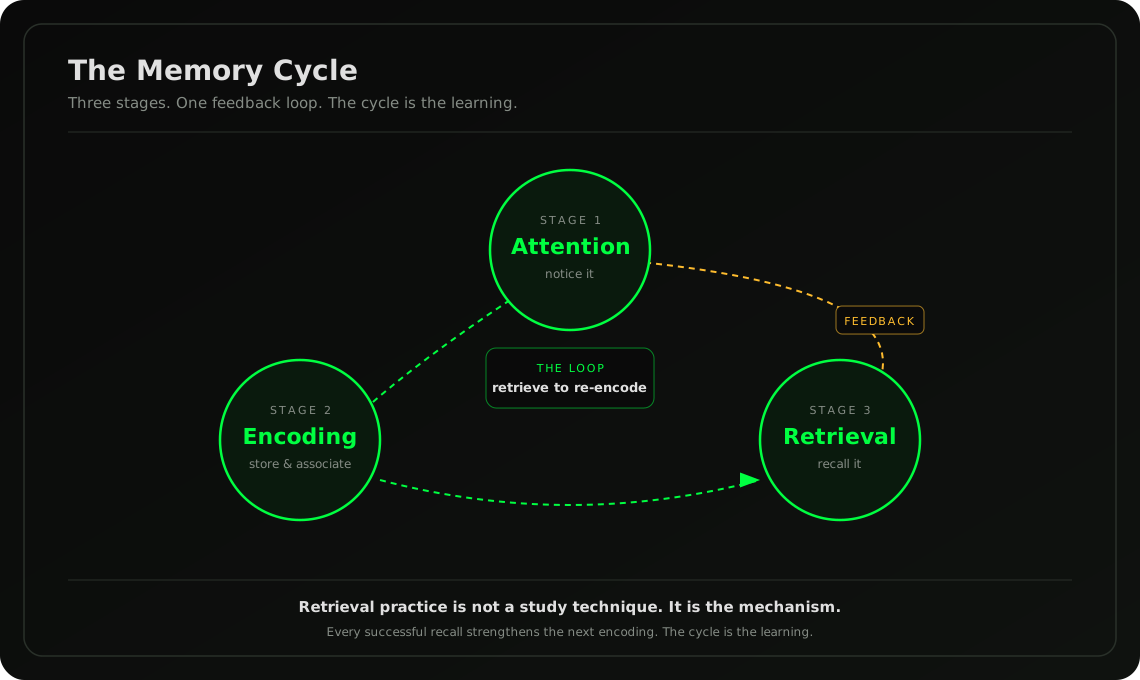
To optimize the final stage, you have to optimize the first two. If you never paid attention to it, you never encoded it. If you encoded it weakly, you cannot retrieve it. But here is the part most students miss: retrieving something makes you pay attention to it again, which lets you re-encode it better than before. The cycle is the learning. Every time you successfully recall something, you have just made it easier to recall the next time. This is why retrieval practice — quizzing yourself — beats passive review by a wide margin. It is not a study technique. It is the mechanism of memory itself.
The GOAT ME framework
Six principles cover most of what the cognitive science literature has to say about studying. I learned them as the acronym GOAT ME and they have not let me down in a decade.
G — Generate and test. Quiz yourself. Come up with the answer on your own, without first reading it. Even when you get it wrong, the attempt is worth more than passively reading the correct answer, because it forces you to think about why the wrong answer was wrong. Test yourself the way you will be tested. If the exam is essays, write essays — multiple times, without cheating, then review and repeat. Teaching the material to someone else, or talking about it out loud to an empty room, works for the same reason: you are forcing retrieval under realistic conditions.
O — Organize. Organization reduces cognitive load and turns position, color, and spatial relationships into free reminders. A timeline does not just show you that event A came before event B; it puts event A to the left, and your brain remembers the position even when it cannot recall the date. The chunking trick is the same principle in miniature. CIAFBIKGBCNNUSABBCUK is genuinely harder to remember than CIA FBI KGB CNN USA BBC UK. Nothing changed except the organization. The information is identical.
A — Avoid illusions of learning. This is the trap that swallows the most students. There are two kinds of memory: recognition and recall. Recognition is when you cannot think of the answer on your own but recognize it when you see it. Recall is when you can produce the answer unprompted. The exam tests recall. Rereading trains recognition. So does highlighting the first time you read a chapter. You feel like you are picking out the important parts, but you cannot know what is important until you have read the whole thing — and then you will just reread the highlights, which is the same problem at smaller scale. The fluency trap is worse: the more you read a passage, the smoother the reading feels, and the easier it feels, the more you assume you have learned it. You have not. You have just gotten better at reading those particular words. Rereading is the most common study habit in the world and one of the least effective.
T — Take breaks. Memory consolidates during rest. A long cram session does not give the brain time to store what you studied at the beginning, so most of it just slips out. Short, frequent sessions over days beat a single marathon by a wide margin. Sleep is not optional — memories are stored more permanently after sleep, and an all-nighter will undo days of otherwise good study. A student of mine taped questions on the bathroom wall and answers on the opposite wall, so every trip to the bathroom became a 90-second retrieval session. The method is silly. The result is not. Walking away is not laziness. It is the consolidation phase.
M — Match learning and testing conditions, then deliberately un-match them. This is the only principle with a built-in contradiction, and the contradiction is the point. The principle of encoding specificity says that the conditions surrounding encoding — where you are, how tired you are, what mood you are in, even your sitting position — become part of the memory and serve as retrieval cues. If you study in a quiet bedroom and the exam is in a noisy lecture hall, you have made the material harder to retrieve. The fix is to study under many different conditions: noisy places and quiet ones, with and without coffee, morning and night, standing and sitting. The more conditions you study under, the fewer conditions you need to retrieve under. The information comes easily regardless of circumstance. If you want to remember something outside the classroom, you must study it in the world.
E — Elaborate. Make the material do work. Connect it to other things you know, ask why it is true, imagine it visually, relate it to your own life, draw a stick figure for it, make up a song. Memory works by association: one thing reminds you of another, which reminds you of another. The more associations a piece of information has, the more routes lead back to it, and the more likely you are to retrieve it under any given circumstance. Elaboration is also the principle that allows for genuine individuality in study habits. Some people learn by drawing. Some by talking. Some by writing songs. Some by imagining the historical figures in motion. None of these methods is intrinsically better than the others. What matters is that the material gets connected to other things, not just recorded.
The two principles that survive every compression
If the six above feel like too much to remember, these two will carry most of the weight:
- Sleep and short sessions beat cramming. Memory consolidates during rest. This is the most replicated finding in the cognitive science of learning, and the one students most consistently ignore.
- Match your study conditions to your test conditions — but if you want to remember outside the test, vary your conditions deliberately. This is the only principle with the contradiction, and the contradiction is the answer.
One more thing the teachers never said
If you can, take notes before the lecture. Read the chapter in advance, sketch a few notes, then show up. The reason is not productivity. It is attention. The first stage of memory is attention, and there is no way to fully pay attention to a professor while you are frantically transcribing what they are saying. You are dividing the resource at the exact moment it matters most. Pre-reading and pre-noting let you spend the lecture paying attention rather than typing.
Most students I have taught this to push back. They say they can pay attention and write at the same time. They are wrong. The research is consistent, and the failure mode is invisible: the notes look fine, the lecture feels engaged, and then the exam comes and the material vanishes.
The whole thing in one sentence
The methods that work are the methods that respect what memory actually is: not a recording device, but a network of associations strengthened by repeated retrieval and consolidated by rest. The methods that do not work — highlighting, rereading, cramming, recognition-only review — all share one feature. They feel like studying. They just are not.
DISCUSSION CHANNEL
Comments
Sign in with GitHub to join the discussion.