ARCHITECTURE LOG
The Science of the Akashic Field
What if 'ether' and 'akasha' are not rivals but translations of the same intuition, both reaching for the substrate behind the visible?
The most interesting sentence I have read in a book on physics this year is from Arthur Zajonc’s Catching the Light. He writes, after cataloguing the experiments that supposedly killed the ether: “If we take both seriously and suppose light to be, in some sense, a wave, then what is it that is waving? In the cases of water waves, sound waves, vibrating strings, something is always waving. The figure of sound is borne by air. What bears the fleeting figure we call light? One thing has become certain, whatever it is, it is not material.”
The ether was supposed to be the answer. The Michelson–Morley experiment killed it in 1887. Light kept behaving like a wave anyway, which means the question — what is waving? — never went away. It migrated. It crossed from physics into philosophy, then into a corner of theosophy that was already talking about the same thing under a different name, in a different vocabulary, with a completely different method of investigation.
Two traditions, one intuition, two centuries apart. That is the story of the Akashic field.
What the theosophists meant
The Sanskrit word akasha is usually translated as ether, sky, or atmosphere. In the older Indian philosophical systems it names the subtlest of the five elements — earth, water, fire, air, ether — and “subtlest” does not mean rarest. It means closest to whatever the elements are made of. The tradition treats it as a screen on which the image of the body and all nature is projected. The screen is not material, but it is not nothing. It is the medium through which the more concrete elements become visible.
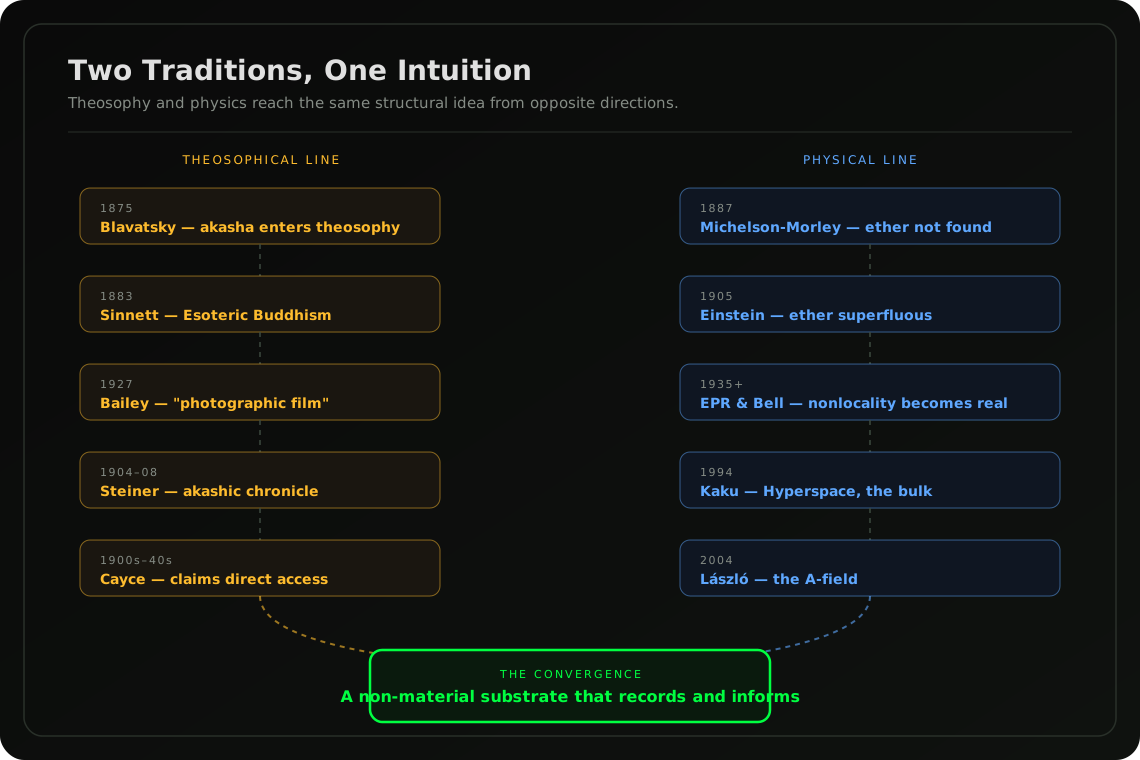
Helena Blavatsky brought the term into Western esoteric language in the late nineteenth century, and her student Alfred Percy Sinnett spread it through his 1883 book Esoteric Buddhism. In the 1920s, Alice Bailey — writing about the Yoga Sutras of Patanjali — described the akashic record as “an immense photographic film, registering all the desires and earth experiences of our planet.” Every human life. Every reaction of the animal kingdom. Every thought-form of karmic nature. The recording is happening constantly, in a non-physical plane called the mental plane. A trained clairvoyant, in the tradition, can read it. Rudolf Steiner used the concept extensively in his work on Atlantis and Lemuria. Edgar Cayce, the most famous of the American mystics, claimed direct access. Whether or not any of these claims are true is a separate question. What matters for the present argument is that all of them are pointing at the same intuition: there is a substrate, and the substrate records.
What the physicists meant
The physicists, working in a completely different idiom, were asking the same question from the other side. Nineteenth century physics needed an ether to explain how light waves could propagate through apparently empty space. The ether was supposed to be a stationary, immaterial, all-pervading medium. The Michelson–Morley experiment failed to detect it. The Lorentz–FitzGerald contraction saved the appearances. Einstein’s 1905 paper on special relativity declared the ether superfluous — not disproven, just unnecessary. Most physicists dropped it.
A few did not. Zajonc’s question — what is waving? — kept the door open. In Hyperspace (1994), Michio Kaku argues that light can be explained as a vibration in a higher-dimensional space, and that “higher dimensional space, instead of being an empty, passive backdrop against which quarks play out their eternal roles, actually becomes the central actor in the drama of nature.” What the nineteenth century called the ether, modern string theory might call the bulk of a higher-dimensional manifold. The vocabulary is different. The intuition is the same.
In 2004, the systems theorist Ervin László published Science and the Akashic Field: An Integral Theory of Everything. He takes the concept out of the theosophical lineage and places it in the language of contemporary physics. The “A-field” is, in his framing, the quantum vacuum itself — not empty space, but a non-local information-carrying field that informs not just the current universe but all universes past and present. The substance of the cosmos is not matter. The substance of the cosmos is information, and the information persists.
László’s hypothesis sits at the edge of mainstream physics, which is a polite way of saying most working physicists would not put it on their desk. But the questions his hypothesis is trying to answer are not fringe. Quantum nonlocality is real. Quantum entanglement is real. The fine-tuning of the universe for the production of galaxies and conscious lifeforms is a genuine puzzle. Evolution does not look random once you know enough biology. None of these are resolved. None of them are closed.
The interesting part
The interesting part is not which tradition is right. It is that the question recurs. Two methods of inquiry, separated by language, by culture, by the entire apparatus of what counts as evidence, both generated the same structural intuition: visible reality is the surface of a deeper recording medium, and the medium is the thing.
The theosophists reached it by introspection, by meditation, by what they called clairvoyance. The physicists reached it by mathematics, by failed experiments, by the unkillable observation that waves need something to wave in. The theosophists called the medium akasha. The nineteenth century called it ether. Modern physics calls it the quantum vacuum. László calls it the A-field. String theorists call it the bulk. None of these are the same claim. All of them are answering the same question.
I do not know whether the answer is right. I am not sure the question is the kind that has a right answer. But I notice that the question does not go away, no matter which way you approach it. The ether was killed in 1887. A hundred and thirty years later, the physics community is still writing papers about whether vacuum fluctuations are real, whether information is conserved in black hole evaporation, whether the constants of nature are fixed or whether they vary across the multiverse. The intuition that there is a substrate, and the substrate records, refuses to die. It just changes costumes.
The question most people miss
Most people, when they encounter the Akashic field, want to know whether it is real — whether there is literally a cosmic recording medium that clairvoyants can read. That is the wrong question. The right question is the one Zajonc asked: what is waving?
If the answer turns out to be “nothing, the wave is the fundamental thing,” then the substrate is not a place. It is a structure. The akashic record, in that case, is not a cosmic filing cabinet. It is a pattern in the wave itself — persistent, transmissible, recoverable. Alice Bailey’s “immense photographic film” becomes, in modern language, a constraint surface on the quantum state of the universe. The vocabulary is unrecognizable. The intuition is the same.
If the answer turns out to be “something, and the something is non-material,” then the theosophists were doing natural philosophy under a different name. Their claim was never that the akasha was magical. Their claim was that the most fundamental layer of reality is informational rather than material. The physicists, in the quantum-information picture, are saying exactly that. They are just saying it in equations.
The interesting story is that the claim survived the century that was supposed to kill it, that it migrated through languages and disciplines, and that it is, in some form, the working hypothesis of the most ambitious theories in contemporary physics. Whether the theosophists were right or wrong, they were asking the right question. So were the physicists. They are still asking it. So are we.
DISCUSSION CHANNEL
Comments
Sign in with GitHub to join the discussion.