ARCHITECTURE LOG
What Tesla Got Right
In 1930, Nikola Tesla published an article predicting the future of energy, materials, and medicine. About half of it was prescient. The other half is a window into how great minds err.
In July 1930, a 74-year-old man living in a series of New York hotels that he could not afford paid a New York American editor to publish an essay. The man was Nikola Tesla. The essay was called Man’s Greatest Achievement. The framing was grand. The predictions were sweeping. The reception was polite, the way polite was reserved for the once-famous who were no longer quite famous enough to dismiss.
Tesla was not yet the Tesla of the internet. He was not the unit of magnetic flux density, the electric car brand, the cult figure of 2010s nerd culture. He was an aging inventor in a hotel room, mostly forgotten, occasionally quoted, no longer taken seriously by the physics establishment. The essay is the work of a man at the end of a long career looking forward to a future he had spent a lifetime trying to bring about. Reading it now, almost a century later, is a strange experience. Some of it is breathtakingly correct. Some of it is wrong in ways that tell you something about how prediction works.
What the essay actually says
The article is short, lyrical, and confident. It opens with a passage that would not be out of place in a contemporary essay on climate and energy:
“With the advent of spring we return from the inner world of thought to the outer world of action. The world lies before us like a great eternal riddle. It invites us to explore, to probe, to ascertain the truth of the principles of life and of the universe.”
Then it makes a foundational claim: all energy on Earth is solar energy, directly or indirectly. The wind is the sun heating the atmosphere unevenly. The rain is the sun evaporating the oceans. The coal is the sun’s energy stored by plants millions of years ago. Therefore, the right way to power human civilization is to tap the sun’s energy as directly as possible. This is the entire premise of the modern renewable energy movement, written in 1930.
Then Tesla lists a series of specific devices. A generator that produces electricity from cosmic rays. A means of transmitting energy wirelessly over long distances using resonant frequencies. A device he calls the “artificial tide” that extracts energy from the natural motion of the oceans. A new metal, “impervious to corrosion, with electrical resistance several times lower than copper.” A medical device called the “telautomaton” that transmits electrical impulses into the body to cure disease. He proposes charged particles as a form of nearly infinite-cycle energy storage.
It closes with the question that has stayed with me since I first read the essay:
“Can Man control this grandest, most awe-inspiring of all processes in nature? Can he harness her inexhaustible energies to perform all their functions at his bidding, more still — can he so refine his means of control as to put them in operation simply by the force of his will?”
Read that last clause. Simply by the force of his will. Tesla is not just asking whether humanity will learn to harvest natural energy. He is asking whether humanity will learn to control nature by mind. The question is partly scientific, partly mystical, and entirely characteristic of the man.
The scorecard
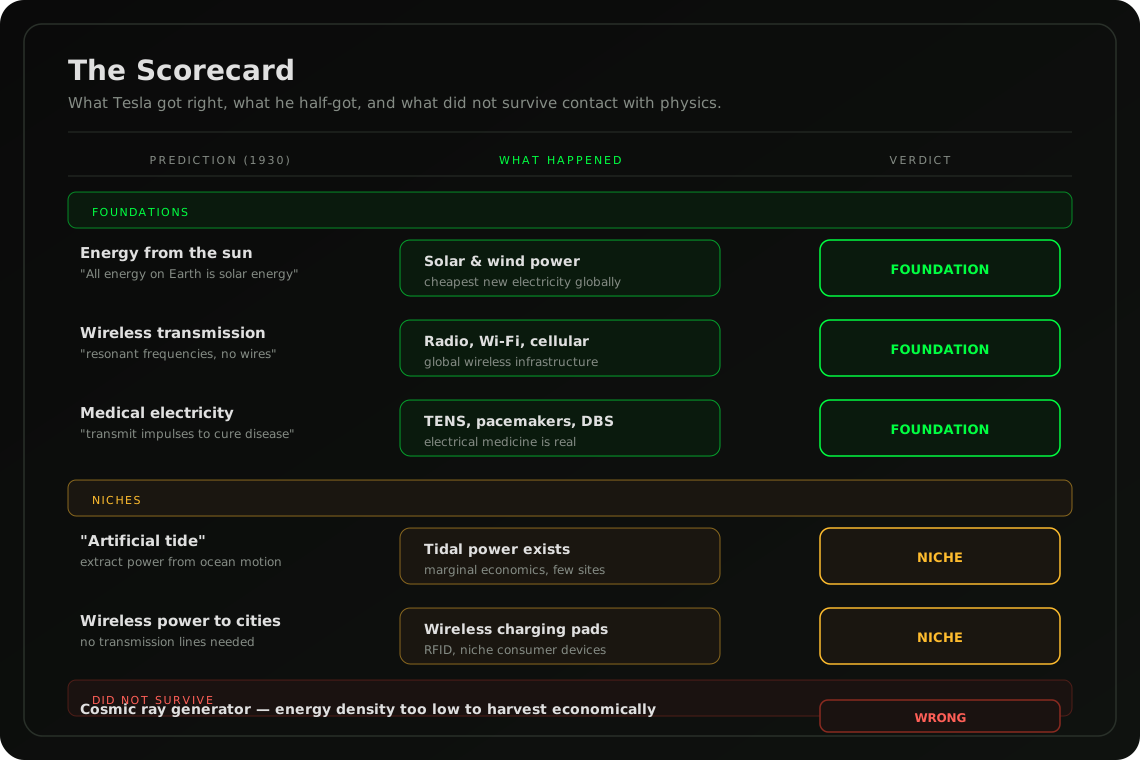
A century on, the predictions sort into three piles.
The ones that were right. The renewable energy premise has become the foundation of the energy transition. Solar and wind are now the cheapest sources of new electricity generation in most of the world, and the fundamental insight — that the right strategy is to capture the sun’s energy as directly as possible rather than burn its ancient residue — is the operating principle of climate policy. Tesla’s framing of the problem was essentially the framing the IPCC would use almost a century later. The wireless transmission intuition was right in spirit, even if the specific technology (resonant frequency transmission to whole cities) was not. Radio, television, mobile phones, Wi-Fi, satellite communication, GPS — all of them descend from the work Tesla did in the 1890s, and all of them validate the claim that the world is connected by invisible waves, and that those waves can be made to do work. The medical electricity intuition was also directionally right. TENS units exist. Pacemakers exist. Deep brain stimulators exist. We are not treating disease by force of will, but we are treating disease with electricity, exactly as Tesla proposed.
The ones that were half right. The “artificial tide” was a real attempt to design a tidal power generator. Tidal power exists today, but the economics are marginal — the places where tidal gradients are strong enough to be worth exploiting are few, and the engineering challenges are large. Tesla’s instinct that the ocean contains enormous extractable energy was correct. His specific device was not. Wireless power transmission, the central obsession of his later career, did not happen in the form he imagined. We do not beam electricity through the air to power our cities. What we did do is far more useful: we built a global infrastructure of radio communication, satellite uplinks, and cellular networks, and we transmit information through the air cheaply. Tesla’s vision of energy transmission through the air is, in practice, a small niche (RFID tags, wireless charging pads) that consumes a fraction of a percent of the world’s electricity. The instinct was right. The economics were wrong.
The ones that were wrong. The cosmic ray generator does not exist and probably cannot exist as Tesla described it. Cosmic rays are real, but the energy density of cosmic rays at the Earth’s surface is too low to be a useful generation source, and no scheme has been found to amplify it economically. The “Tesla metal” was never produced. There are corrosion-resistant alloys today — stainless steels, titanium alloys, conductive copper alternatives — but none of them emerged from Tesla’s specific process, and his claims about properties “several times lower” than copper have not been substantiated. The “telautomaton” did not cure disease by electrical impulse. Modern electroconvulsive therapy is real and used, but it does not cure the range of conditions Tesla described, and the “force of will” framing of medical intervention has not panned out.
The pattern of the errors
The pattern is more interesting than the score. Tesla’s right predictions share a feature: they were predictions about direction, not about specific technology. He was right that the future of energy is solar and wind. He was wrong that the future of energy is cosmic ray generators. He was right that wireless energy transmission was a meaningful idea. He was wrong that it would replace the grid. He was right that medical electricity was an underexplored domain. He was wrong that it would cure disease at the snap of a switch.
The wrong predictions all share another feature: they require physics that did not exist and has not been found. Cosmic ray generators depend on cosmic rays being much more energetic and harvestable than they are. Tesla metal depends on a fabrication process that does not produce a metal with the claimed properties. The telautomaton depends on a theory of disease that electrical pulses can broadly treat, which has not been borne out.
There is a useful pattern here for anyone who reads predictions, including predictions being made today. The right predictions tend to be ones about which direction the world is going. The wrong predictions tend to be ones about which specific technology will get us there. The direction is much easier to see than the technology. Tesla saw the direction. He did not see the technologies. None of us reliably do.
What the question at the end is really asking
Tesla’s last line in the essay is the line that stayed with me. Can man so refine his means of control as to put them in operation simply by the force of his will? The question is not quite the question it sounds like. He is not asking whether we will develop telekinesis. He is asking whether the relationship between humanity and the natural world will become so close that the boundary between controlling and commanding will dissolve.
The answer to his question, almost a century later, is mixed. We have learned to control a great deal. The sun’s energy falls on solar panels and becomes electricity. The wind turns turbines. Radio waves carry information across the planet. Medical devices use electricity to keep hearts beating. We have not learned to do it by force of will. We have learned to do it by engineering, by trial and error, by the unglamorous and continuous work of figuring out which predictions were right and which were wrong.
Tesla’s 1930 essay is worth reading because it shows what a great mind looks like when it is part right and part wrong, in roughly equal measure. The right half is now the foundation of how we generate electricity. The wrong half is now a useful reminder that the inventor’s instinct is not the same as the physicist’s prediction. The closing question, asked by a 74-year-old man in a hotel room he could not afford, is still the right question. We are getting closer to the answer. We are not there. We are probably not as close as Tesla thought. We are closer than he could have known.
DISCUSSION CHANNEL
Comments
Sign in with GitHub to join the discussion.