ARCHITECTURE LOG
Was Thanos Right?
A thought experiment on population, resources, and the ethics of utilitarian extremes.
Avengers: Infinity War works as more than a superhero film because Thanos is not a nihilist. He has a premise, a method, and a moral justification. That is what makes him frightening. The question is not whether he is evil; the question is whether his reasoning is coherent.
Thanos looks at the universe and sees finite resources meeting exponential demand. His solution is to eliminate half of all life at random, painlessly, without prejudice. The horror is not in the cruelty. It is in the tidiness.
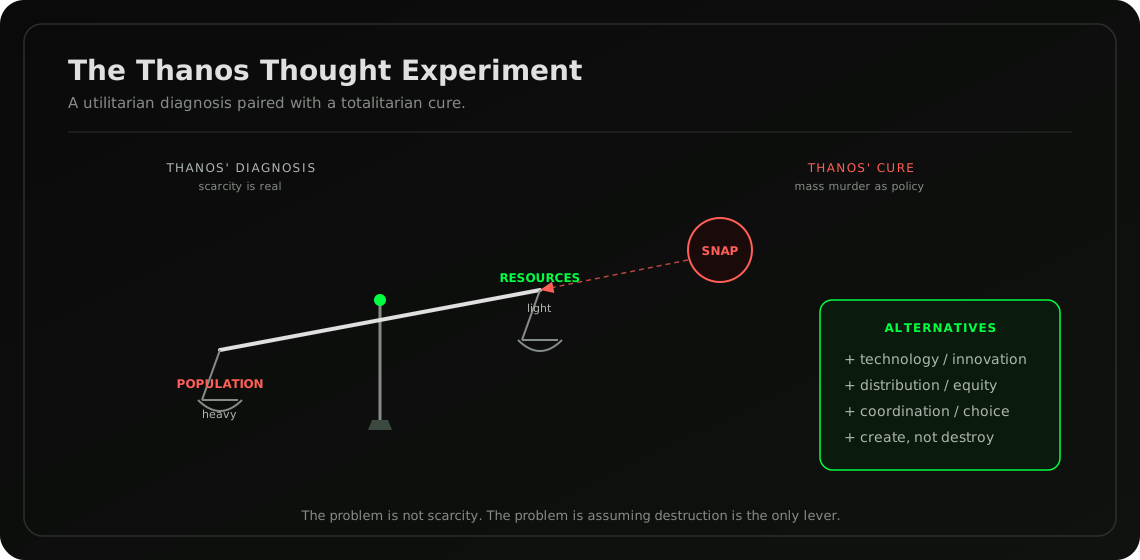
What Thanos gets right
Resource scarcity is a real problem. Civilizations can outgrow their carrying capacity. Ecosystems collapse. famine, conflict, and suffering follow when demand consistently exceeds supply. Thanos is not wrong to notice the tension between population and resources. He is wrong about almost everything else.
The first error is framing. He treats life as the variable to adjust, not scarcity. A systems thinker would ask why resources are limited, how they are distributed, and what interventions expand capacity. Thanos skips those questions because his real commitment is not to balance. It is to decisive action.
The Malthusian mistake
Thanos is a Malthusian. He assumes population grows exponentially while resources grow linearly, making catastrophe inevitable. The trouble is that this model has been wrong for centuries. Human societies do not simply consume finite pies. They invent new recipes.
The green revolution multiplied agricultural output. Fertilizer, irrigation, and genetics turned scarcity into surplus. Energy transitions expanded usable resources faster than raw extraction could. None of this means limits do not exist, but it does mean that limits are not static. Technology, institutions, and choices reshape them. Thanos’s universe has six stones of infinite power, yet he uses them to delete life rather than create abundance. That is not necessity. It is imagination failure.
The hubris of the snap
The snap is appealing because it is fair. Random selection spares the rich and the poor at equal rates. No one is targeted by race, class, or belief. But fairness in method does not excuse horror in outcome. Randomly murdering half of all sentient beings is still murder on a cosmic scale.
The deeper problem is what the snap assumes about authority. One being decides that the survival of the many justifies the annihilation of the many. The contradiction is obvious once you say it out loud. Thanos is not saving the universe from collapse. He is collapsing it himself and calling the rubble balance.
This is the totalitarian pattern: identify an existential threat, declare normal ethics suspended, appoint yourself the sole competent decision-maker, and promise future gratitude for present horror. It never ends well, even when the architect genuinely believes he is merciful.
What a god could actually do
Thanos claims to act like a god, but his power is purely destructive. A being with infinite power over reality could generate resources, slow reproduction through non-lethal means, reshape ecosystems, or teach civilizations to coordinate. The stones make scarcity optional. Thanos makes death mandatory.
That asymmetry is revealing. His solution is not the best available option. It is the one that confirms his self-image as the only one willing to do what must be done. The suffering is the point. It proves the seriousness of his commitment.
The philosophical trap
Thanos is often read as a utilitarian because he talks about the greatest good for the greatest number. But classical utilitarianism does not license genocide as a first resort. It requires comparing all available actions and choosing the one that maximizes well-being. The snap fails that test because better options exist and Thanos ignores them.
He is closer to a deontological nightmare: a single principle — balance — elevated above every other value, including life, consent, and autonomy. The result is not ethics. It is aesthetic morality, where the clean line matters more than the living world it cuts through.
Why the question still matters
Thanos is wrong, but he is wrong in a useful way. He forces the viewer to ask how far they would go to prevent catastrophe. Climate change, pandemic response, and resource allocation all involve versions of this tension: individual freedom versus collective survival, present cost versus future benefit, local harm versus global good.
The lesson is not that hard choices are avoidable. It is that hard choices are rarely as clean as villains pretend. Any policy that requires you to stop counting individual lives has already stopped being policy and started being pathology.
Thanos was not right. He was coherent enough to be dangerous.
DISCUSSION CHANNEL
Comments
Sign in with GitHub to join the discussion.