ARCHITECTURE LOG
Man is a machine
Are we biological machines, or is there something in us that cannot be reduced to mechanism?
The claim that man is a machine is not absurd. Your heart is a pump. Your lungs are bellows. Your neurons fire in patterns that predict your next move before you are aware of making it. From the outside, the human body looks like an extraordinarily complex mechanism obeying physical law. The question is whether that is all we are.
The history of the idea is useful. Julien Offray de La Mettrie argued in L’Homme Machine (1747) that humans are nothing more than sophisticated automata. Descartes, a century earlier, went the other way: the body is a machine, but the mind is an immaterial substance interacting with it. Both views share a mistake. They assume that if the body is mechanical, the mind must be either identical to it or separate from it. There is a third option.
What the machine thesis gets right
Reductionism works. Physics explains chemistry. Chemistry explains biology. Biology explains the firing patterns that correlate with your thoughts. No one seriously doubts that damaging a specific brain region will alter a specific mental function. The brain is not a radio receiving signals from elsewhere. It is the organ of the mind.
This is why the machine thesis keeps winning. It produces predictions. It builds prosthetics, diagnoses disorders, and models decision-making. Treating the body as a mechanism is not a philosophical preference. It is a research strategy that delivers results.
Where it overreaches
The overreach happens when mechanism is treated as an exhaustive account. To say that a brain state correlates with pain is not the same as saying pain is the brain state. The first is a third-person description. The second is an identity claim that does not obviously follow.
Consider the difference between describing a chess computer and being the chess computer. From outside, you see silicon, voltage, and algorithms. From inside, if it were conscious, there would be something it is like to calculate a move. The outside view does not obviously contain the inside view, even if it determines it. This is the hard problem of consciousness: why does any physical process have an inner feel at all?
Emergence as the middle path
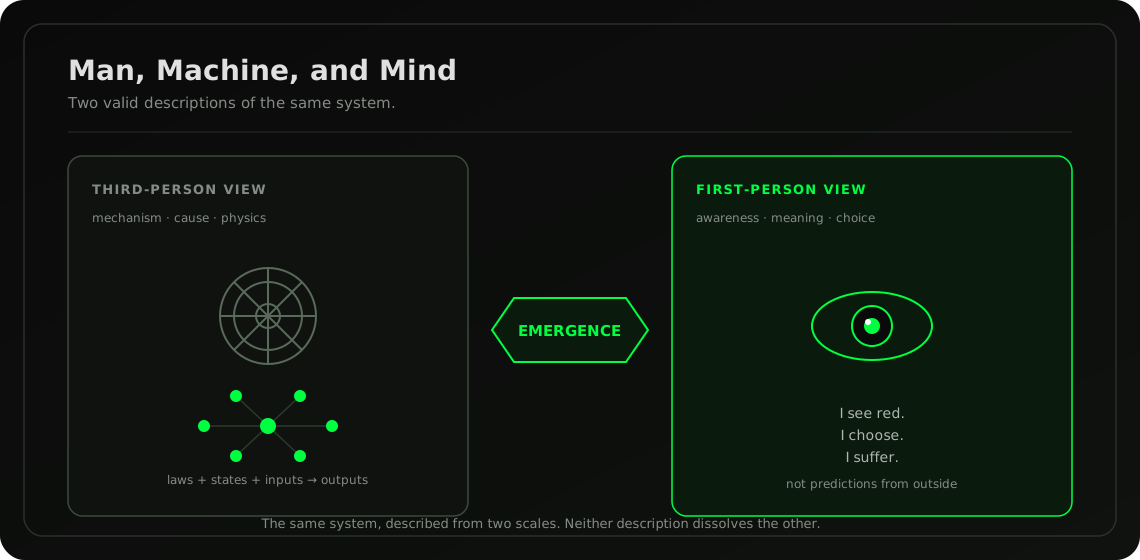
The better answer is emergence. A single water molecule is not wet. Wetness is a property that appears when many molecules interact under certain conditions. In the same way, consciousness may be what happens when a sufficiently integrated information system operates in a particular mode. The system is entirely physical, yet its behavior is not usefully described at the level of atoms.
This does not rescue a separate soul. It also does not reduce experience to mechanism. It says that reality has layers. Physics is the base layer. Biology is a higher layer. Mind is higher still. Each layer is compatible with the one below, but each has its own vocabulary and its own truths.
Free will in a causal universe
If we are mechanisms, our choices are determined by prior states. If we are conscious agents, we seem to author them. The two pictures conflict only if you insist that causation and agency are rivals.
Compatibilism offers a cleaner framing. A choice is free when it flows from your own reasons, values, and deliberation, even if those reasons are themselves caused. A choice is unfree when it is coerced, manipulated, or disconnected from who you are. Freedom is not the absence of causation. It is the right kind of causation.
This matters practically. Morality and law assume that people can be reasons-responsive. That assumption is compatible with the brain being a causal system. We do not need a soul outside physics to hold someone responsible. We need a mind that can respond to reasons.
The dilemma of desire and pain
Even if we accept emergence, the human condition does not become comfortable. We are machines of desire, wired to chase, acquire, and reproduce. We are also machines of pain, built to register loss, threat, and limitation. These forces are not bugs. They are the operating system that keeps us alive.
But we are not only those forces. We can observe them. We can delay gratification, endure discomfort for a future good, and question whether a desire is worth pursuing. That capacity for self-reference — to think about our own thinking — is what makes the machine interesting. A thermostat responds to temperature. A human can ask why it prefers one temperature over another.
What to do with this
The answer to “Are we machines?” is yes and no. Yes, at the level of physics and biology. No, at the level of lived experience. The question is not which side wins. The question is which vocabulary fits which task.
When you are sick, think like a mechanism. When you are choosing, thinking, or relating to another person, think like a subject. The mistake is to treat either frame as the whole truth. We are not ghosts in machines. We are not merely machines either. We are conscious biological systems, and the mystery is not that one of these descriptions is wrong. The mystery is that both are right.
DISCUSSION CHANNEL
Comments
Sign in with GitHub to join the discussion.