ARCHITECTURE LOG
Elon Musk on xAI
Notes on Musk's vision for understanding the universe through AI.
Elon Musk’s xAI launch was framed as another AGI moonshot. The stated goal is to build a “maximum curious” artificial general intelligence focused on understanding the universe. The founding team includes alumni from DeepMind, OpenAI, Google, and Tesla. The press coverage focused on the competition with OpenAI and the timeline predictions.
What stayed with me was not the mission statement. It was the reasoning habit underneath it.
The physics instinct
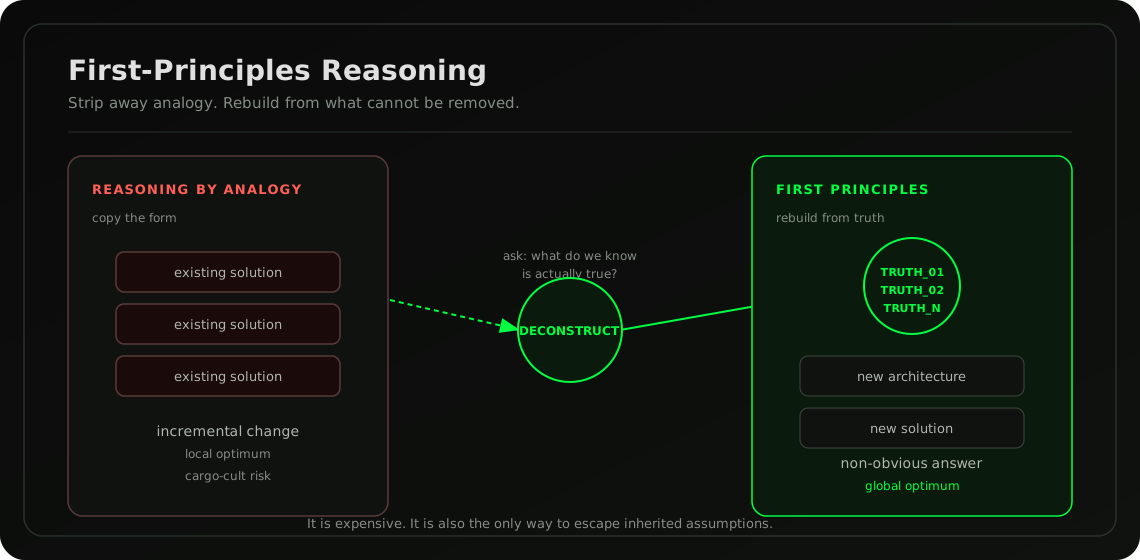
Musk talks constantly about first-principles reasoning. The idea is simple: instead of copying what already exists, ask what is actually true, then rebuild from there. Battery packs cost too much? Do not accept the market price. Break the battery into cobalt, nickel, aluminum, and carbon on the London Metal Exchange, add the manufacturing energy, and rebuild the cost curve from the floor up. Rockets cost too much? Do not accept aerospace pricing. Ask what the raw materials weigh and what it costs to shape them.
This is not a business tactic. It is a discipline. It forces you to separate the thing itself from the social consensus around the thing. Most engineering organizations optimize inside inherited assumptions because those assumptions are invisible. First-principles reasoning makes them visible, which is uncomfortable and slow, but it is the only reliable way to find non-obvious solutions.
What it changed in my own work
I work on security architecture and adversarial systems. The field is full of inherited shapes: the compliance checklist, the SIEM dashboard, the annual pentest, the vendor-shaped control plane. Those are useful starting points. They are also traps if you stop there, because they train you to optimize inside a picture of security that someone else drew.
The Musk-style question I keep returning to is: what is the irreducible thing we are actually trying to guarantee? Not “what does a security program usually look like?” but “what must remain true for an adversary to fail?” The answer, for me, keeps coming back to three invariants: the system must remain observable, the attack path must remain interruptible, and the adversary must not be able to exceed the authority we have delegated to any component. Every control — detection, segmentation, logging, hardening — is just an implementation of one of those three.
That reframe changes the design. Instead of layering conventional controls on top of an existing architecture, you start by asking which invariant each control enforces and where the invariant can fail. It is harder than copying a SOC 2 checklist. It is also the only way to avoid building security theater.
xAI’s actual bet
Applied to AI, Musk’s first-principles move is to question whether current systems are even pointed in the right direction. His argument, during the launch, was that today’s large models are optimized to be plausible rather than true. They are trained to predict tokens, not to minimize the gap between belief and reality. xAI’s proposed correction is to build an AGI that is “truth curious,” one that prefers a true but uncomfortable answer over a flattering false one.
That is easier to announce than to implement. Truth is not a loss function you can just add. But the framing is useful. It forces a distinction between capability and orientation. A system can be powerful and still be aligned with the wrong target. The first-principles question is not “how big is the model?” but “what is the model trying to be right about?”
The danger of cargo-culting the method
There is a risk in admiring Musk’s method too easily. First-principles reasoning is not the same as ignoring constraints, burning people out, or dismissing expertise. You can deconstruct a problem and still be wrong. You can rebuild from fundamentals and still build something nobody wants. The method does not guarantee success. It only guarantees that your failures will be your own.
What it does guarantee is clarity. If you have genuinely rebuilt an argument from the ground up, you know where your assumptions live. You can defend them or change them. If you have merely copied the form of a first-principles thinker — the blunt questions, the dismissal of precedent, the aggressive timelines — you have cargo-culted the aesthetic without getting the discipline.
The personal takeaway
The part of the xAI launch that influenced me was not the promise of AGI by 2029. It was the reminder that most of what looks like innovation is actually analogy in disguise. In security, in AI architecture, and in writing, the hard move is to stop borrowing the shape of existing answers and start from the constraints that are actually binding.
Musk may or may not succeed at xAI. The market will decide that. But the habit he keeps demonstrating — the refusal to accept a problem as it has been handed to you — is worth stealing. The universe is under no obligation to make sense through inherited categories. Neither is your next design.
DISCUSSION CHANNEL
Comments
Sign in with GitHub to join the discussion.