ARCHITECTURE LOG
The Epicurean Paradox from Advaita Vedanta
How non-dual philosophy reframes the problem of evil.
The Epicurean Paradox is a clean piece of logic. If God is willing to prevent evil but not able, he is not omnipotent. If able but not willing, he is malevolent. If both able and willing, whence cometh evil? If neither able nor willing, why call him God? The argument is not that God does not exist; it is that the traditional description of God collapses under the fact of suffering.
Most responses stay inside the frame. They tweak omnipotence, redefine benevolence, or invoke free will. Advaita Vedanta does something more radical: it denies that the frame itself is ultimate.
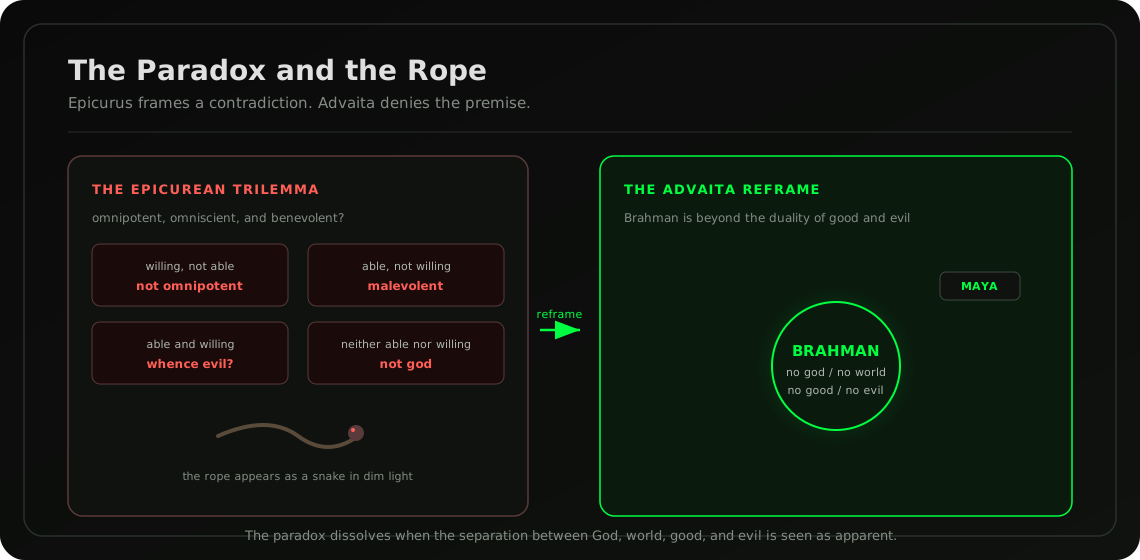
The trap assumes a theistic structure
The paradox works because it treats God as a being among beings: a person-like entity with attributes, standing outside the world, choosing whether to intervene. Evil is treated as a real substance that needs explanation. The whole puzzle depends on these separations: God and world, good and evil, creator and created.
That structure is not universal. It is one way to organize religious experience, and it happens to be the way that produces the problem of evil. Advaita Vedanta starts elsewhere.
Advaita: the rope and the snake
In Advaita, the ultimate reality is Brahman: not a person, not a creator, not a being with attributes, but the undivided ground of all that is. The world we perceive — with its multiplicity, its suffering, its moral categories — is the play of Maya, the power of appearance. The classic metaphor is mistaking a rope for a snake in dim light. The snake is not nothing; it is experienced. But it is not what is really there.
Good and evil, on this view, are not independent realities. They are judgments made from a limited perspective. From the perspective of the rope, there is no snake. From the perspective of Brahman, there is no separate world requiring rescue.
Why the paradox dissolves
The Epicurean question asks why God permits evil. Advaita answers that the question presupposes a God who could permit or forbid, and an evil that exists on its own. Both presuppositions are provisional.
Brahman is beyond good and evil in the same way that the ocean is beyond the distinction between this wave and that wave. The wave may experience itself as separate, threatened, and in competition. The ocean does not. Evil is real at the level of the wave; it is not ultimate at the level of the ocean.
This is not a denial of suffering. Suffering is experienced. The Advaita claim is that suffering depends on the identification of the self with the limited body-mind. Avidya, or ignorance of one’s true nature as Brahman, is the root. Remove the ignorance and the problem of evil becomes, at the limit, a problem that no longer arises.
The practical move
The Advaita resolution does not ask us to stop helping people or to stop judging cruelty. It operates at a different level. As long as we are in the world of appearances, morality remains real and binding. The reframe is metaphysical, not ethical.
What changes is the context. The problem of evil is no longer evidence against God’s existence. It becomes evidence of the ignorance that makes the world seem fractured in the first place. The response is not theodicy but inquiry: investigate the nature of the self until the question loses its force.
A limitation worth naming
This answer will not satisfy everyone. If you are inside suffering, a metaphysical reframing can sound like evasion. A parent who has lost a child is not consoled by being told that evil is illusory. The Advaita tradition knows this, which is why it pairs metaphysics with ethical preparation, devotion, and disciplined practice. The intellectual answer is only one limb of the path.
The value of the answer is not that it ends grief. It is that it shows the problem of evil is not necessarily a refutation of the sacred. It may simply be a symptom of looking at reality through the wrong lens.
The takeaway
Epicurus builds a trap for a specific kind of God. Advaita Vedanta refuses to enter the trap by denying that God and world are ultimately separate, and that good and evil are ultimate categories. The resolution is not a clever move within the paradox. It is a step outside the assumptions that make the paradox possible.
The question shifts from “Why does God allow evil?” to “Who is asking, and what do they take themselves to be?” That second question is harder. It is also the one that might actually change something.
DISCUSSION CHANNEL
Comments
Sign in with GitHub to join the discussion.