ARCHITECTURE LOG
Nietzsche and Vedanta: Unexpected Parallels
Unexpected resonances between the will to power and the self beyond the ego.
Friedrich Nietzsche and Vedanta make an unlikely pair. One is a 19th-century German critic of Christianity and morality, the other a millennia-old Indian inquiry into the nature of the self. Yet they converge on a single idea: the categories we inherit — good and evil, self and world, illusion and reality — are not final. They are constructs to be seen through.
Where they differ is what to do after the seeing-through. Nietzsche wants creation. Vedanta wants realization.
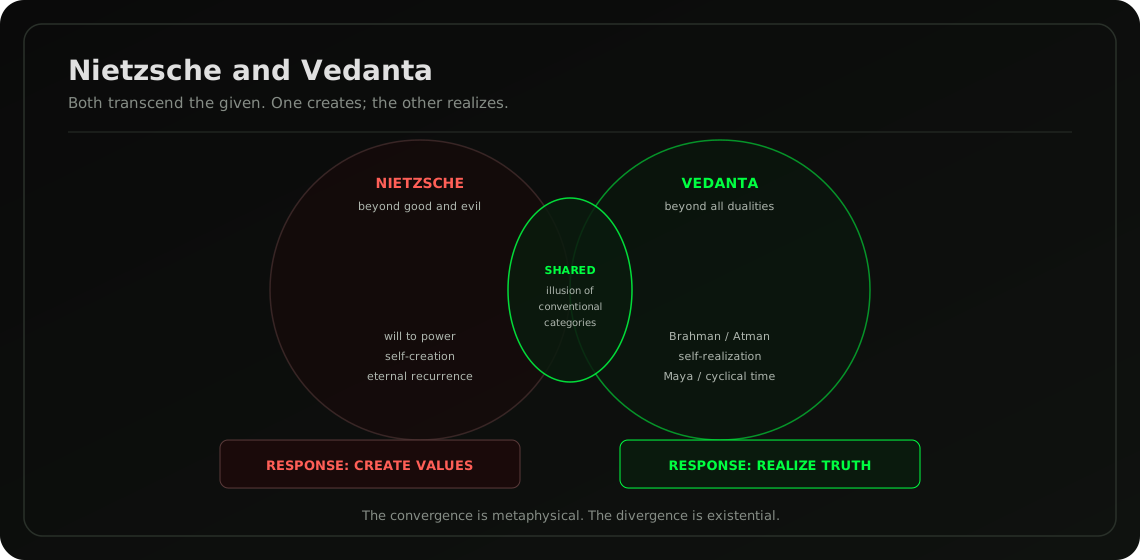
Beyond dualities
Nietzsche’s Beyond Good and Evil is not a call to immorality. It is a call to stop accepting the moral table we have been handed. He sees good and evil not as features of the universe but as expressions of power: the strong and the weak each invent values that serve their condition. To remain inside those values is to remain inside a resentment you did not choose.
Vedanta makes a similar move at the metaphysical level. Brahman, the ultimate reality, is beyond all dualities. Good and evil, true and false, self and other — these are products of Maya, the power of appearance. They are valid for practical life but not ultimate.
Both philosophies ask us to stop treating conventional distinctions as absolutes. Nietzsche does it to make room for new values. Vedanta does it to reveal the non-dual ground beneath them.
The self: Übermensch and Atman
For Nietzsche, the Übermensch is the individual who transcends received morality and creates meaning through will and self-overcoming. The self is not a given; it is a project. You become what you are by affirming your power, accepting suffering, and refusing the comfort of herd values.
For Vedanta, Atman is the opposite of a project. It is what remains when all projects are dropped. The self is not something to be built. It is something to be discovered, already identical to Brahman. The ego — the anxious, striving, story-telling self — is the obstacle, not the raw material.
This is the central tension. Nietzsche says the self is an artwork in progress. Vedanta says the self is an illusion to be dissolved. Both are forms of liberation, but they point in different directions.
Illusion and reality
Nietzsche treats society, morality, and religion as illusions in the sense that they are interpretations. They are not lies; they are perspectives. Some perspectives are healthier than others, but none are final. The task is not to discover the one true perspective but to create one strong enough to affirm life.
Vedanta treats the world itself as appearance. Maya is not a lie either; it is the power by which the one appears as many. The task is not to invent a better interpretation but to wake up from interpretation altogether. The rope is not a snake, and the self is not separate from Brahman.
Nietzsche would likely find Vedanta too passive, too eager to dissolve the very individuality he spent his life affirming. Vedanta would likely find Nietzsche still trapped in the ego’s drama, mistaking self-creation for freedom.
Cyclical time
Nietzsche’s eternal recurrence asks: what if this life, exactly as it is, recurs forever? The test is whether you can affirm it. If the thought crushes you, you are living by values you do not truly own. If it liberates you, you have said yes to existence.
Vedanta and Hindu cosmology also use cyclical time, but to a different end. The Yugas describe vast cosmic cycles of creation, preservation, and dissolution. Time is not a line leading to progress; it is a wheel. The point is not to affirm your particular life but to see through the cycle itself.
Both reject linear redemption. Nietzsche wants you to redeem this life by loving it. Vedanta wants you to transcend the one who needs redemption.
Asceticism: denial and discipline
Nietzsche hated asceticism when it meant life-denial — the body as enemy, desire as sin, existence as punishment. He saw this as resentment dressed up as holiness, a clever way for the weak to dominate the strong.
Vedanta’s asceticism is not life-denial in the same sense. It is a discipline of attention, designed to weaken the ego’s grip so that the self can be recognized. The world is not evil; it is simply not ultimate. Renunciation is a tool, not a metaphysical verdict.
The difference is subtle but real. Nietzsche rejects asceticism because it says no to life. Vedanta practices it because it wants to see life clearly.
The divergence that matters
The convergence is metaphysical. Both traditions say the conventional world is not the whole story. The divergence is existential. Nietzsche responds with creation: new values, new selves, new affirmations. Vedanta responds with realization: the dissolution of the separate self into what already is.
Neither answer is obviously wrong. The question is which one fits the person asking. Some people need to create. Others need to stop creating and notice.
Why read them together
Reading Nietzsche and Vedanta together is useful because each exposes the limitation of the other. Nietzsche saves Vedanta from quietism: transcendence is not an excuse to stop engaging with life. Vedanta saves Nietzsche from inflation: self-creation can become another ego project if it is not grounded in something larger than the self.
The honest position is to hold both. The categories we inherit are provisional. We are free to create beyond them. And the self that creates is not ultimately separate from the reality it creates within.
DISCUSSION CHANNEL
Comments
Sign in with GitHub to join the discussion.