ARCHITECTURE LOG
Revisiting the Unabomber
A critical reading of Kaczynski's critique of technology, separated from his violence.
Ted Kaczynski killed three people and injured dozens more in a bombing campaign that lasted nearly two decades. There is no separating that fact from his manifesto, Industrial Society and Its Future, because the violence was the point. The manifesto was not a philosophical argument that happened to be published by a murderer. It was the justification for murder.
That does not mean every observation in it is false. The useful question is whether we can separate the critique from the cure.
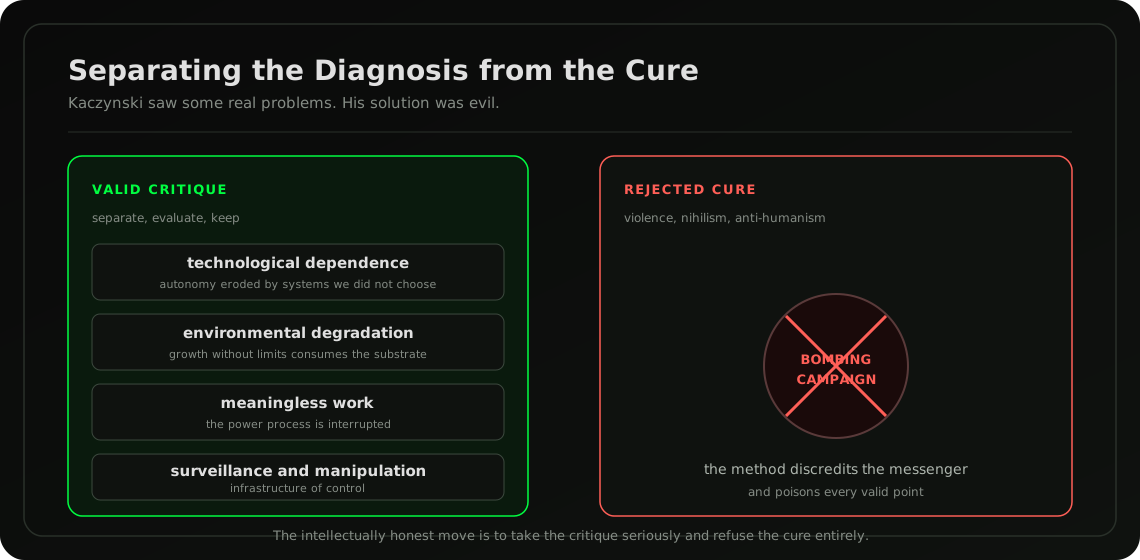
The valid critique
Kaczynski’s core argument is that industrial-technological society systematically strips people of autonomy. We depend on complex systems we did not design, do not understand, and cannot easily leave. Our work is increasingly specialized, abstract, and disconnected from tangible outcomes. Our attention is harvested by platforms that optimize for engagement over well-being. Our environment is consumed to sustain growth that is treated as an end in itself.
These are not fringe observations in 2024. They are mainstream.
- Technological dependence: Smartphones, cloud services, and algorithmic feeds mediate more of daily life than most people consciously chose. The infrastructure is convenient; the dependency is real.
- Environmental degradation: Climate change, biodiversity loss, and resource extraction are not side effects. They are the operating mode of a system that treats the planet as a substrate for economic output.
- Meaningless work: Kaczynski called it the disruption of the “power process” — the human need to identify goals, exert effort, and see results. Large organizations often fragment this process into tasks so narrow that no single person experiences the whole.
- Surveillance and manipulation: The same tools that connect people also profile them, nudge them, and filter their reality. The business model is attention; the side effect is control.
Taken together, this is a coherent critique of modernity. It is also not original to Kaczynski. Similar arguments appear in Jacques Ellul, Lewis Mumford, and the Luddite tradition. The problem is not that he noticed these things. The problem is what he concluded.
The rejected cure
Kaczynski’s solution was the destruction of industrial society by any means necessary, including the murder of civilians. He believed that technology was a total system with no reformist escape, and that the only authentic human life was one outside it.
This conclusion fails on its own terms. If the critique is that industrial society dehumanizes people, then killing random individuals in the name of that critique is an acceleration of the very dehumanization it claims to oppose. The manifesto’s logic requires its readers to value human life so little that they can accept terror as a teaching method. Once you accept that, the critique about autonomy becomes a joke.
There is also the practical failure. Industrial society did not collapse because of Kaczynski. It absorbed him into a true-crime narrative and kept running. Violence as propaganda rarely produces the intended conversion. It produces fear, backlash, and martyrdom for the wrong side.
What to keep
The intellectually honest move is to take the critique seriously and reject the cure entirely. We do not need to blow up the machine. We need to build alternatives inside and around it.
That means:
- Decentralized infrastructure: protocols, mesh networks, and self-hosted tools that reduce dependency on a few corporations.
- Digital rights: privacy law, encryption, and user control over data.
- Local production: food, energy, and manufacturing at smaller scales where it makes sense.
- Meaningful work: organizations that keep the power process intact by giving people ownership of outcomes.
- Environmental limits: treating the planet as a finite system rather than an infinite resource.
None of this requires rejecting technology categorically. It requires rejecting the assumption that every new technology is progress, and that every inconvenience should be automated away.
The harder question
Kaczynski’s real challenge is not “should we return to the wilderness?” It is “how much of modern life is actually chosen, and how much is inherited?” Most people do not choose their employer’s software stack, their city’s car dependency, their nation’s energy mix, or the platforms that shape their attention. These things are given. The work of autonomy is to make them visible, then negotiable, then optional where possible.
This is slower than bombing. It is also the only path that does not require becoming the thing you claim to oppose.
Conclusion
Kaczynski was right about some things and monstrous about the most important thing. The manifesto is worth reading the way a failed surgery is worth studying: not as a model, but as a warning. It shows what happens when a legitimate grievance against modernity hardens into totalizing despair.
The future we need is not Kaczynski’s wild anti-civilization. It is a civilization that takes autonomy, ecology, and human dignity seriously enough to reform itself without bloodshed.
DISCUSSION CHANNEL
Comments
Sign in with GitHub to join the discussion.