ARCHITECTURE LOG
Life is cruel
On injustice, suffering, and meaning in a world without divine guarantees.
There is no kind way to say it: the world does not balance its own ledger. Children get sick. Tsunamis arrive without warning. Cruel people prosper and kind people are broken. If you are waiting for a cosmic force to set things right, you will wait forever.
This is the hard starting point for any honest secular ethics. Not that suffering is meaningful, not that it builds character, not that it will be rewarded elsewhere. Just that it is real, and no one is coming to fix it.
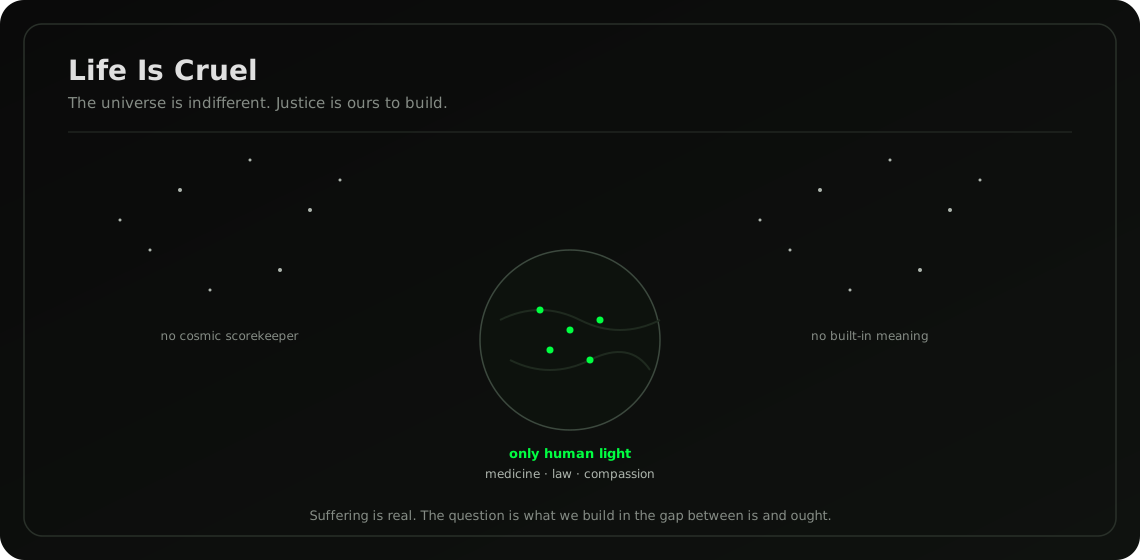
Nature does not care
Much suffering is simply physics and biology doing what they do. Viruses replicate, tectonic plates shift, bodies fail. The COVID-19 pandemic killed millions not because anyone willed it but because a virus found a host and spread. Earthquakes flatten cities because energy built up along a fault line and released. These events are not punishments or tests. They are consequences of a universe that operates without regard for human preference.
Understanding this is liberating in one sense and burdening in another. Liberating because it removes the need to find a hidden meaning behind every tragedy. Burdening because the responsibility for prevention and response falls entirely on us.
We carry ancient instincts in a modern world
Some suffering comes from inside us. Aggression, tribalism, status competition, and short-term thinking were adaptive for our ancestors. They helped small groups survive scarcity and threat. In the modern world, the same impulses produce war, exploitation, and institutional cruelty. We are running firmware from the Pleistocene on hardware built for global coordination.
This is not an excuse. It is a diagnosis. If our worst impulses are partly inherited, then they can be partly managed — through education, institutions, and the slow work of building cultures that reward cooperation over domination.
Systems amplify the cruelty
Individual malice is not the main source of injustice. Systems are. Economic inequality, corrupt governance, broken legal systems, and unaccountable institutions concentrate harm on people who did nothing to deserve it. A poor person in a wealthy country is not suffering because the universe is unfair in the abstract. They are suffering because a specific set of rules distributes resources in a specific way.
This means the problem is tractable. Systems can be changed. Laws can be rewritten. Institutions can be made transparent. The cruelty is not ordained; it is engineered, and what is engineered can be re-engineered.
Meaning is not given
Existentialism takes the indifference of the universe as its starting point. Camus called the gap between our need for meaning and the silence of the world the absurd. His response was not despair. It was revolt: we create meaning by choosing how to live, by taking responsibility, by acting as if our choices matter even though the universe offers no guarantee.
This is the humanist move. If there is no cosmic plan, then the only source of value is us. We decide what counts as just. We build the communities that embody it. We pass it on. Meaning is not discovered. It is constructed, maintained, and defended.
What to do with this
None of this makes suffering disappear. But it changes the question. The question is no longer “why is this happening?” It is “what can I do about it?”
The answer is usually local and unglamorous: support science and medicine, push for fair institutions, teach empathy, participate in your community, and live by a code you are willing to defend. There is no final victory. There is only the continuous work of making the world slightly less cruel than it would otherwise be.
The only justice available
The universe does not owe us fairness. But we owe it to each other. The only justice available is the justice we build — in law, in medicine, in education, and in the small daily choices that add up to a civilization.
Life is cruel. That is not the end of the argument. It is the beginning.
DISCUSSION CHANNEL
Comments
Sign in with GitHub to join the discussion.