ARCHITECTURE LOG
Designing a living ecosystem of AI agents
From static agent teams to adaptive, self-organizing systems.
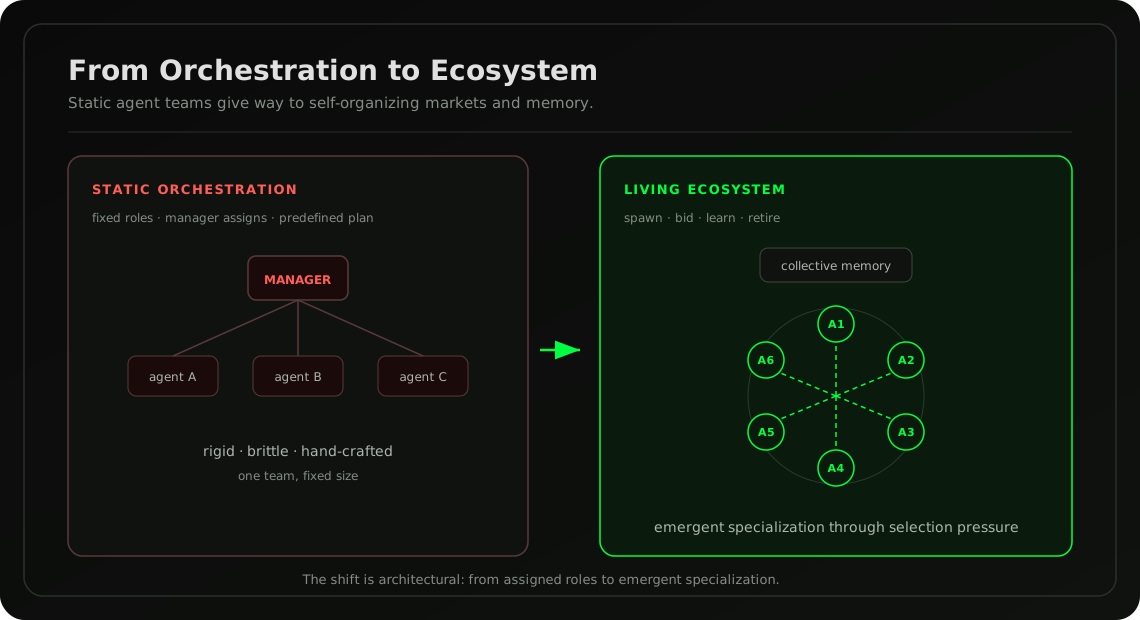
Current agent frameworks — AutoGen, CrewAI, and their successors — let you build teams of AI agents. They are useful, but they manage agents like pieces on a board. Roles are fixed, the plan is predefined, and the orchestrator is the bottleneck. That works for well-understood tasks. It breaks when the environment changes or the task outgrows the original design.
The next architecture is not a bigger orchestrator. It is an ecosystem.
What an ecosystem means
A living agent ecosystem has three properties that separate it from orchestration:
-
Lifecycle, not role. Agents are born, work, reproduce, and retire. A successful agent can spawn improved variants. An idle agent sleeps to save compute. An obsolete agent is removed. The population is dynamic.
-
Markets, not managers. Tasks are not assigned. They are auctioned. Agents bid on work using real metrics: accuracy, latency, cost, and success rate. The best bid wins. Failure removes the agent from the pool temporarily, so the market routes around weakness.
-
Collective memory. Agents share what they learn. A hot cache captures recent experience across active agents. A cold cache stores the system’s long-term history. A distillation process compresses that experience into smaller, more efficient models that become the brains of new agents.
These three properties turn a team into a population.
Why this matters
Orchestrated systems are brittle because they assume you know the answer before you start. You define the roles, the flow, and the failure modes. An ecosystem assumes you do not. It discovers specialization through use. It improves through selection. It recovers through redundancy.
This is not idle biomimicry. There are concrete engineering advantages:
- Efficiency. Resources go to the agents that are actually useful. Unused agents do not consume compute.
- Resilience. No single orchestrator can fail catastrophically because there is no single orchestrator.
- Adaptation. The system can develop unexpected competencies as agents find niches the designer did not anticipate.
- Compression. Distilling collective knowledge into smaller models lowers inference cost over time.
The risks are real
Ecosystems also introduce problems that orchestration avoids. Markets can optimize for the wrong metric. Reproduction can produce degenerate agents that game the bidding system. Collective memory can amplify bias or leak sensitive data. And if the selection pressure is misaligned, the system optimizes for survival rather than usefulness.
These are governance problems, not technical bugs. They require observation, kill switches, and hard constraints on what agents are allowed to optimize. The freedom to evolve must be bounded by invariants that the human operators control.
The architectural shift
The important move is conceptual. Most agent systems today are command-and-control. The ecosystem model is selection-and-memory. Instead of designing the perfect agent team, you design the environment in which agents compete and learn. The intelligence is not in the prompt. It is in the loop.
This also changes how you measure success. You stop asking “did the agent follow the script?” and start asking “did the population improve its ability to handle the task distribution over time?” That is a harder question. It is also the right question for systems that are supposed to operate in open-ended environments.
The bottom line
We are still early. The tooling for agent ecosystems is primitive compared to what exists for static orchestration. But the direction is clear. If AI agents are going to handle complex, changing work, they cannot be hand-managed forever. They will need to manage themselves. The question is whether we design that self-management deliberately or let it emerge chaotically.
DISCUSSION CHANNEL
Comments
Sign in with GitHub to join the discussion.